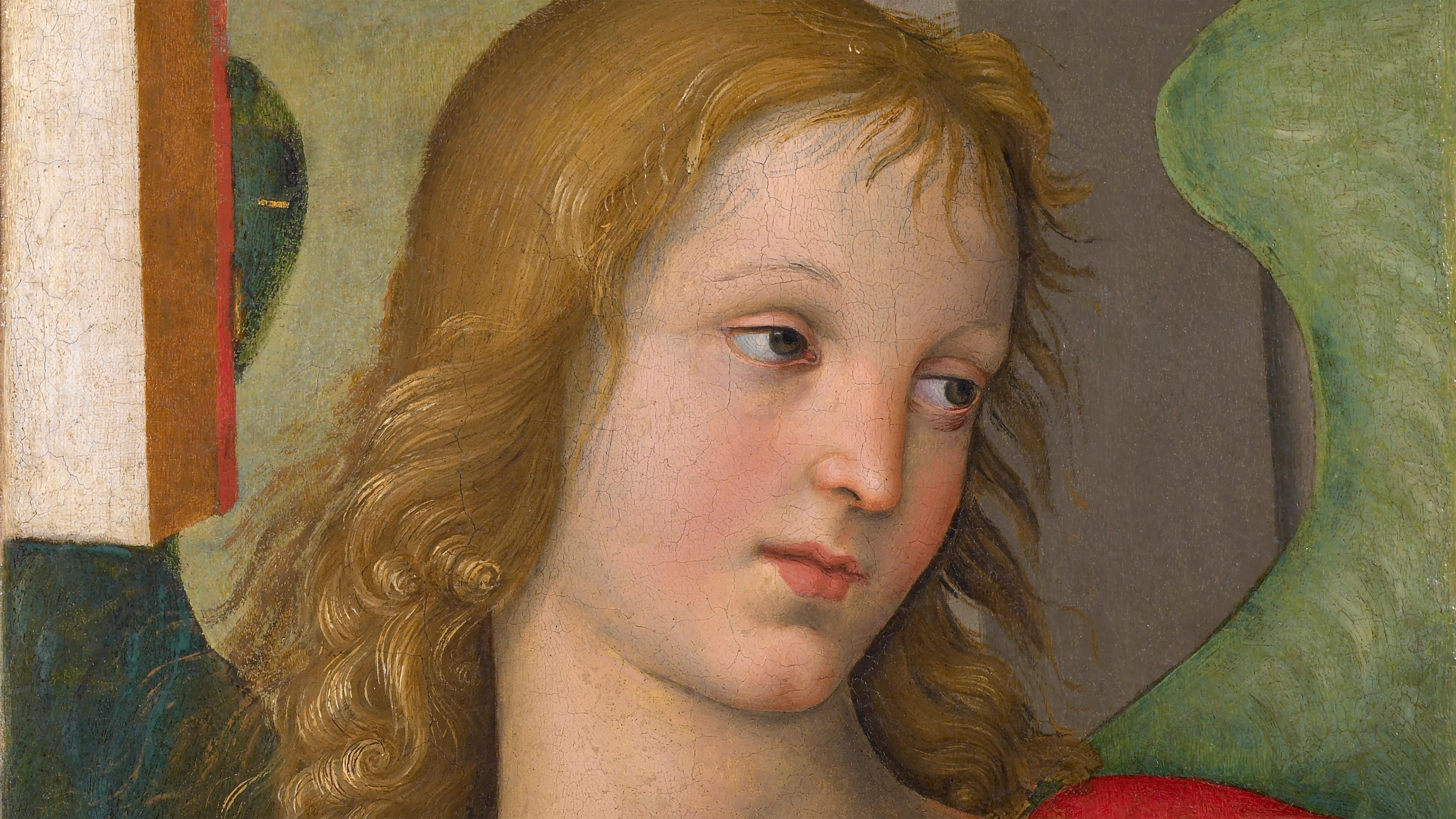
Raphael (Rafaello di Giovanni Santi; 1483–1520) is celebrated today as one of the most important artists of the Italian Renaissance and became an enormous influence on artists in his own lifetime and for centuries that followed. The first comprehensive exhibition on the artist in the United States, Raphael: Sublime Poetry is a look over his shoulder, exploring Raphael’s path from his youth in the central Italian town of Urbino to his triumphant emergence as the most sought-after and admired artist at the pope’s court in Rome. At his death at only thirty-seven years old, Raphael was known as the “Prince of Painters” due to his enormous accomplishments as an artist and his grace in negotiating the complex social, political, and cultural landscape of his time.
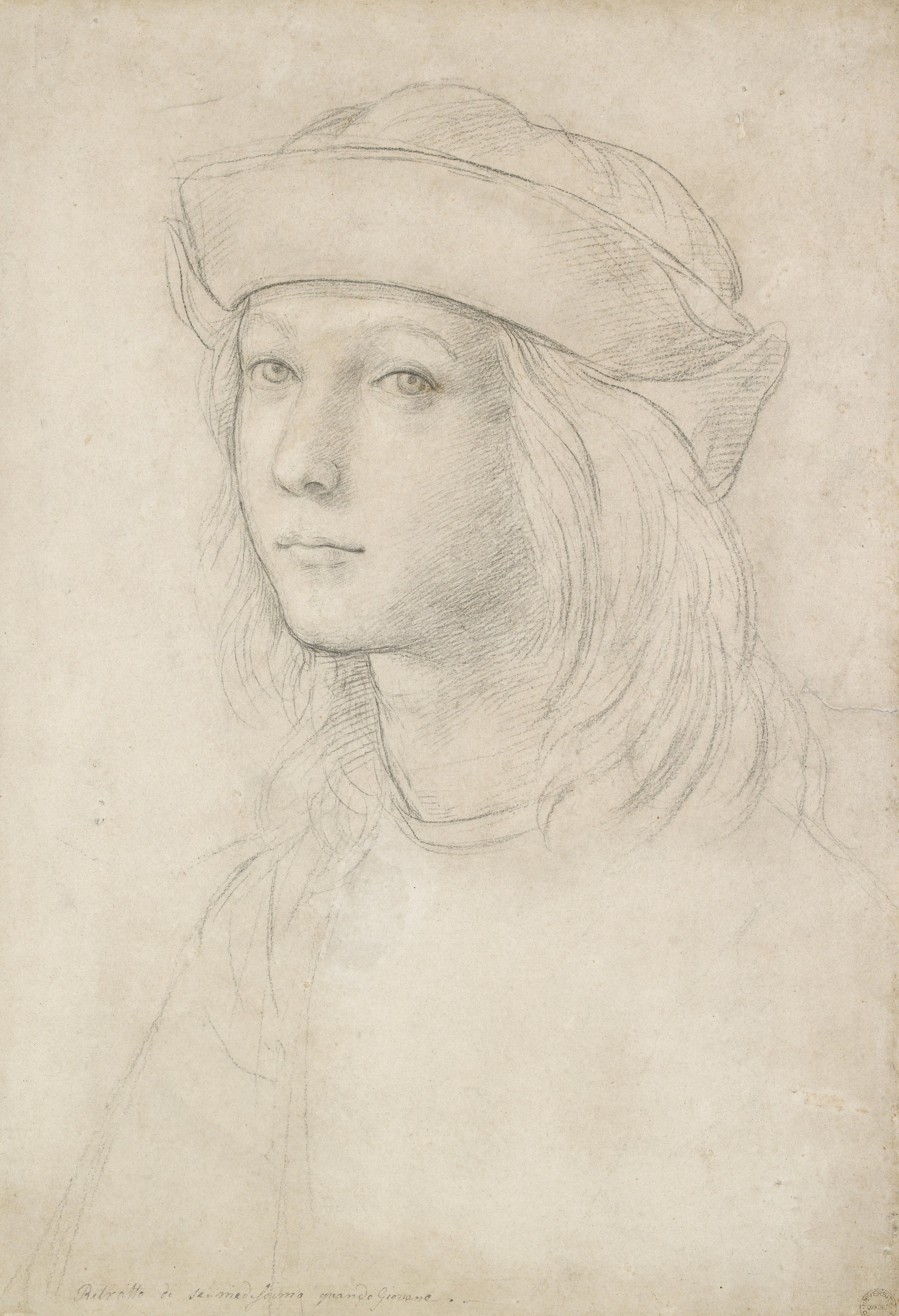
Raphael (Raffaello di Giovanni Santi; 1483–1520). Portrait of a Young Boy (Presumed to Be a Self-Portrait), ca. 1500. Grayish black chalk, highlighted with white (now lost), on laid paper, 15 × 10 1/4 in. (38.1 × 26.1 cm). The Ashmolean Museum, Oxford (WA1846.158)
This drawing, believed to be a self-portrait, demonstrates Raphael’s astonishing talent as a teenager. Born in Urbino, Raphael grew up exposed to the culture of the Marche and Umbria regions rather than the artistic centers of Florence or Rome. Raphael’s father, Giovanni Santi (Giovanni di Sante da Peruzzolo; ca. 1439–1494), was a painter and poet, whose most significant literary work was an epic poem detailing the life and exploits of Federico di Montefeltro, the Duke of Urbino. Santi was likely his son’s first teacher, though he passed away when Raphael was only eleven years old.
Raphael next joined the studio of the renowned artist Perugino (Pietro di Cristoforo Vannucci; 1446/50–1523), from whom he learned not only the technical skills he would need as a professional artist, but also how to run a successful studio. Raphael created this drawing around the time he completed his training with Perugino and became an artist in his own right. Sensitively observed and expertly executed drawings like this one would assure patrons that, despite his youth, Raphael already had extraordinary abilities. In this self-portrait, the artist meets our gaze as he portrayed himself on the cusp of adulthood and artistic independence.
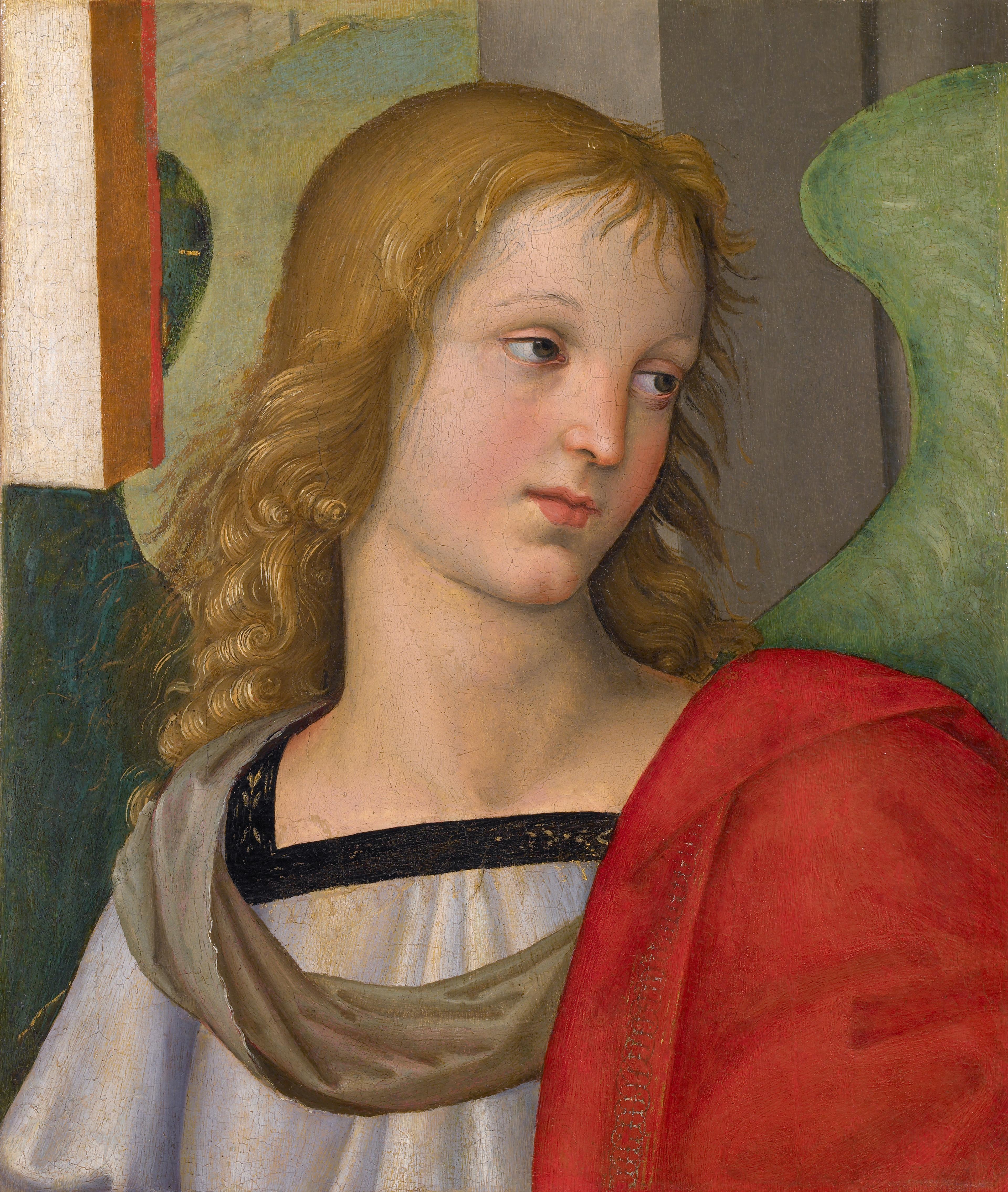
Raphael (Raffaello di Giovanni Santi; 1483–1520). Angel in Bust-Length (Fragment from the Baronci Altarpiece), ca. 1500–1501. Oil with gold highlights on canvas (transferred from wood), 12 3/16 × 10 7/16 in. (31 × 26.5 cm). Pinacoteca Tosio Martinengo e Fondazione Brescia Musei, Brescia (149)
This painting of an angel is only one part of an enormous altarpiece that was later heavily damaged during an earthquake. The contract for this altarpiece survives, and it names the seventeen-year-old Raphael as the magister (master or professional painter), along with another artist, Evangelista da Pian di Meleto (circa 1460–1549). This was an important step in the young artist’s career and a sign that he gained the confidence of patrons as an independent artist in central Italian towns such as Città di Castello. A preparatory drawing shows that it was Raphael, not his older collaborator, who designed the composition for the altarpiece. The radiant technique displayed in the rich colors and delicate strands of golden hair in this fragment further suggests that Raphael was the sole painter of this figure.
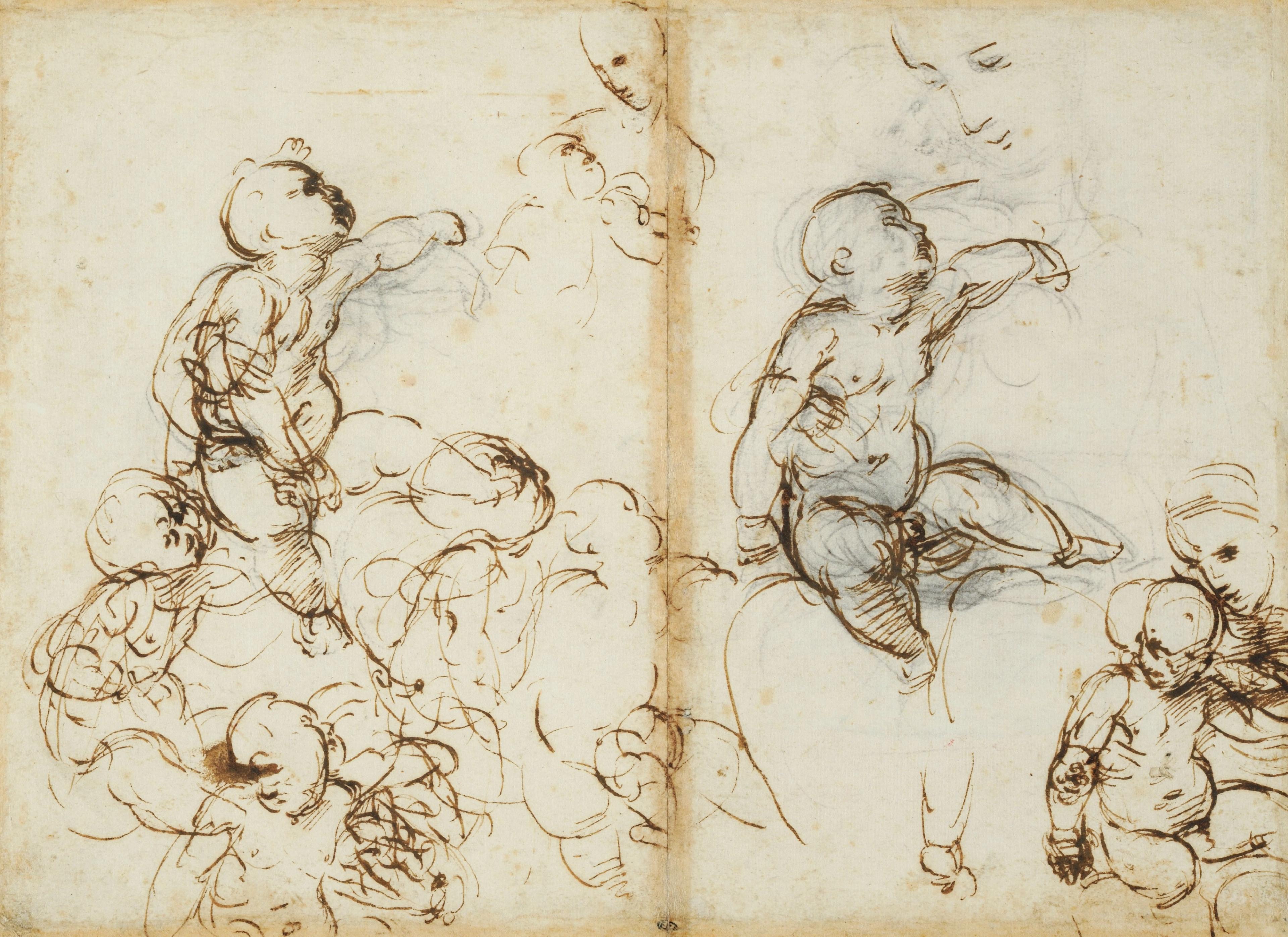
Raphael (Raffaello di Giovanni Santi; 1483–1520). Sketches of Infants; The Virgin and Child, ca. 1507–8. Pen and brown ink, over leadpoint underdrawing (recto), metalpoint, highlighted with white gouache, on paper prepared yellowish pink (verso), 9 × 12 5/16 in. (22.8 × 31.2 cm). Ecole Nationale Supérieure des Beaux-Arts (Beaux-Arts de Paris) (310)
Although Raphael continued to cultivate relationships with patrons and fellow artists in Umbria and the Marche, around 1504 he began to spend time in the city of Florence. He was intrigued by the artistic innovations of Leonardo da Vinci (1452–1519) and Michelangelo (1475–1564) who were both creating some of their most important and influential works in Florence at the time. Leonardo believed that the act of rough, spontaneous sketching (called bozzare pronto) would allow an artist’s creativity to be expressed more fully. In drawings like this one, Raphael wholeheartedly embraced the older artist’s philosophy, quickly sketching many different compositions on one sheet, which was far from the careful, precise drawings he created after studying in Perugino’s workshop.
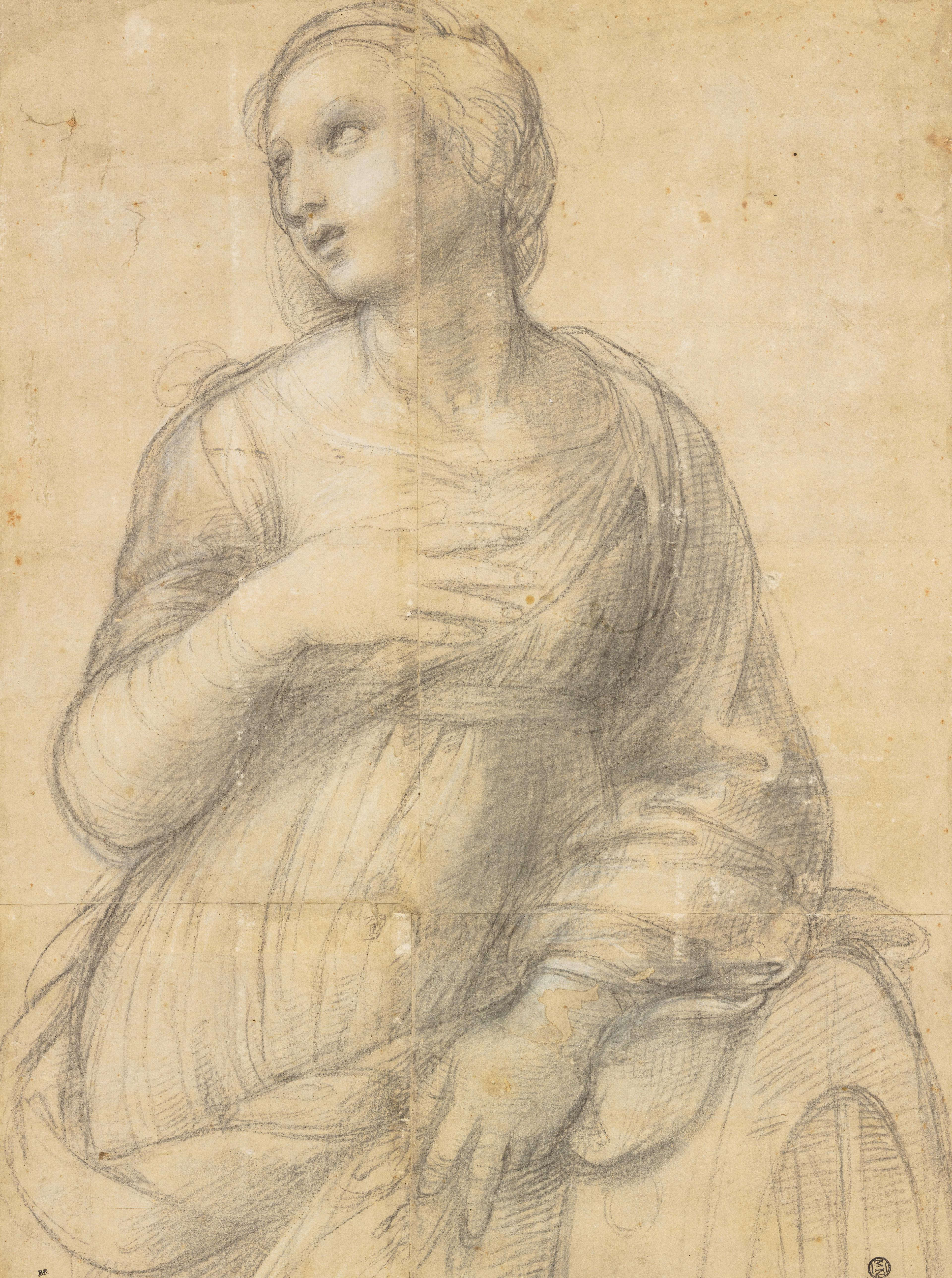
Raphael (Raffaello di Giovanni Santi; 1483–1520). Saint Catherine in Three-Quarter Length, ca. 1507. Charcoal, black chalk, highlighted with white gouache and white chalk, on four sheets of paper glued with overlapping seams (original paper support), outlines pricked for transfer of the design, 23 1/8 × 17 1/4 in. (58.7 × 43.8 cm). Musée du Louvre, Département des Arts Graphiques, Paris (3871)
What Raphael adopted from Leonardo was not only the method of spontaneous sketching, but also his ability to create elegant, yet dynamic compositions. The twisting pose of Saint Catherine in this rare drawing is inspired by Leonardo’s compositions for the painting Leda and the Swan (circa 1508), now lost, which was hugely influential on artists in Leonardo’s circle. The work above was a functional drawing known as a cartoon, meaning it was drawn at full size and then transferred to the painting surface by pricking tiny holes in the design and then pressing through black chalk, called pouncing. This was a technique that he learned at a young age (likely through Perugino) but which continued to be immensely important for the rest of his career as he took on even larger and more ambitious projects.
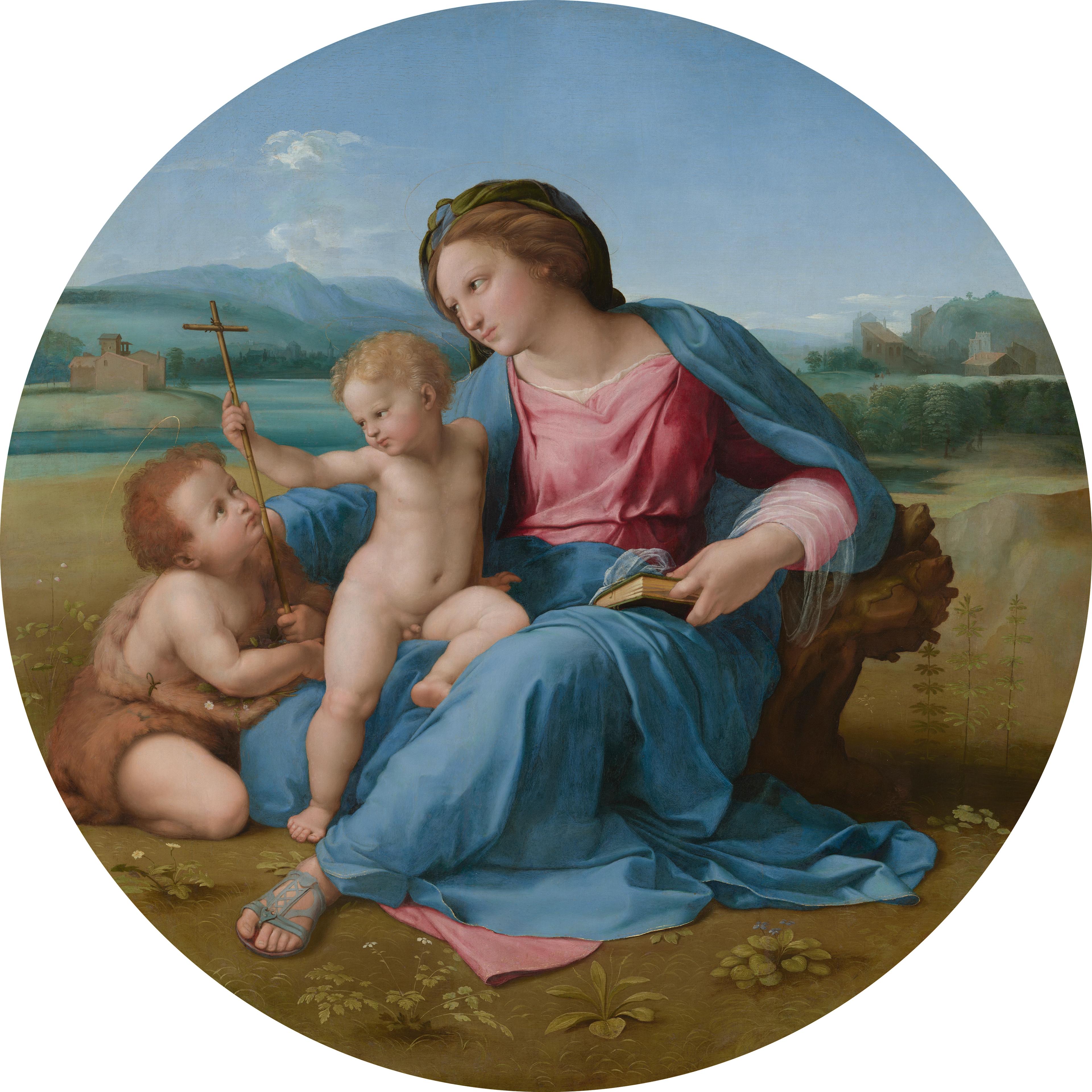
Raphael (Raffaello di Giovanni Santi; 1483–1520). The Virgin and Child with the Infant Saint John the Baptist in a Landscape (The Alba Madonna), ca. 1509–11. Oil on panel transferred to canvas, 37 3/16 in. (94.5 cm). National Gallery of Art, Washington, D.C. (1937.1.24)
Raphael is known today for his extraordinary ability to portray the affection between the Virgin Mary and her child, Jesus Christ, as in this painting from Raphael’s Roman period, known as The Alba Madonna (ca. 1509–11). Raphael began cultivating this specialty while working in Florence. Despite his talent, Raphael could not break into the competitive Florentine art market by winning commissions for large-scale altarpieces or other public religious art. Instead, he gained the approval of patrons with his tender and engaging paintings of the Madonna and Child, intended for display in their homes rather than in churches.
Building on a Byzantine tradition of showing the Madonna and Child in a close embrace (known as the “Madonna of Tenderness”), Raphael emphasized the humanity of Mary and Jesus and the love between them. Limited medical knowledge in the fifteenth and early sixteenth centuries led to a high mortality rate in childbirth for both mothers and babies, so Italians of all classes looked to Mary as a protector, whose blooming health and beauty were aspirational. Raphael understood the impact of maternal mortality all too well: his own mother, Magia Ciarla, died in childbirth when he was only eight years old, with his newborn sister following a few days later.
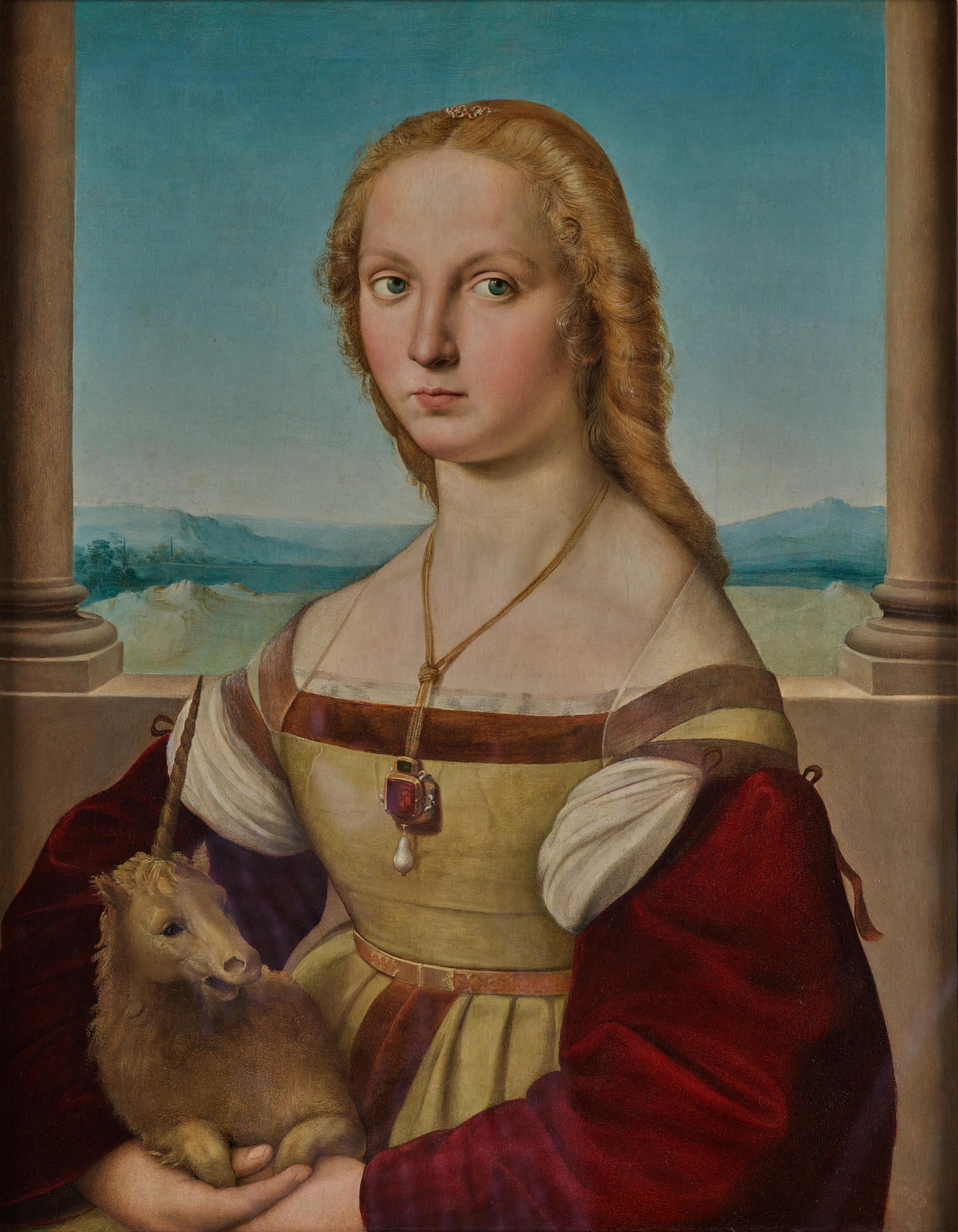
Raphael (Raffaello di Giovanni Santi; 1483–1520). Portrait of a Young Woman with a Unicorn (Laura Orsini della Rovere?), 1505–6. Oil on wood panel, transferred to canvas, glued to a wood support. 26 3/8 × 22 1/16 in. (67 × 56 cm). Galleria Borghese, Rome (371)
Beyond infusing religious paintings with dramatic compositions and emotional depth, Raphael was also an accomplished portraitist. Raphael’s engaging portraits show that he learned from Leonardo that the sitter’s mind was expressed through their body, especially in their gaze and the position of their hands. This painting was likely an engagement or marriage portrait, which is not only suggested by her attire, but also the small unicorn in her arms, a symbol that represented love and chastity and may have also been a reference to her family name. The luxurious materials of the sitter’s elegant costume and jewelry advertised her wealth, status, and “value” as a bride as a matter of her family’s honor. Although this figure has not been firmly identified, she may be Laura Orsini della Rovere (1492–1530/31), the daughter of Giulia Farnese, whose family emblem was the unicorn.
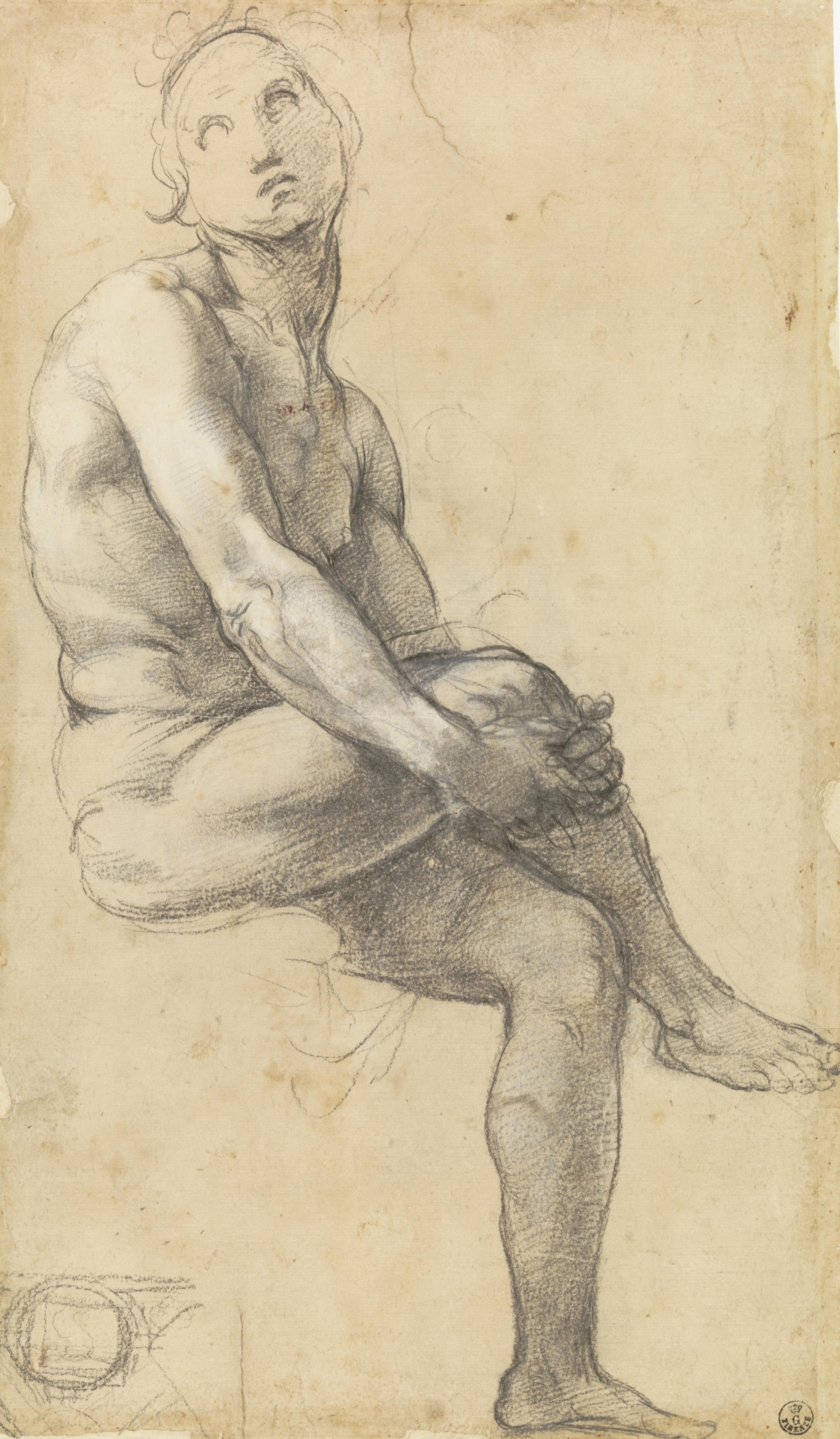
Raphael (Raffaello di Giovanni Santi; 1483–1520). Seated Male Nude (Study for Adam in the Disputa, Stanza della Segnatura); Small Sketch for the Segnatura Vault at lower left, ca. 1509–11. Black chalk and white highlights on yellowed white paper, 14 1/16 × 8 1/4 in. (35.7 × 21 cm). Gallerie degli Uffizi, Gabinetto dei Disegni e delle Stampe, Florence (541 E)
In 1508, Raphael left Florence for Rome, and in that same year, he received a commission that would change the course of his career. Pope Julius II (1443–1513) was in the midst of decorating the papal apartments in the Vatican Palace and commissioned the young artist to fresco the Stanza della Segnatura. For that room, Raphael created two of his most important and influential paintings, The School of Athens and The Disputa (Disputation of the Sacrament), which depicted the ancient philosophers on one side of the room and key figures of Christian theology on the other. Raphael was not highly experienced in the fresco technique when he began this project, but he quickly adapted to the medium. The bold style he adopted in preparatory drawings like this one helped create figures with impact from a distance. This study for the figure of Adam, the first man according to the Old Testament, is one of Raphael’s most extraordinary, with its sculptural anatomy and searching lines as he decided on the best position of the fingers.
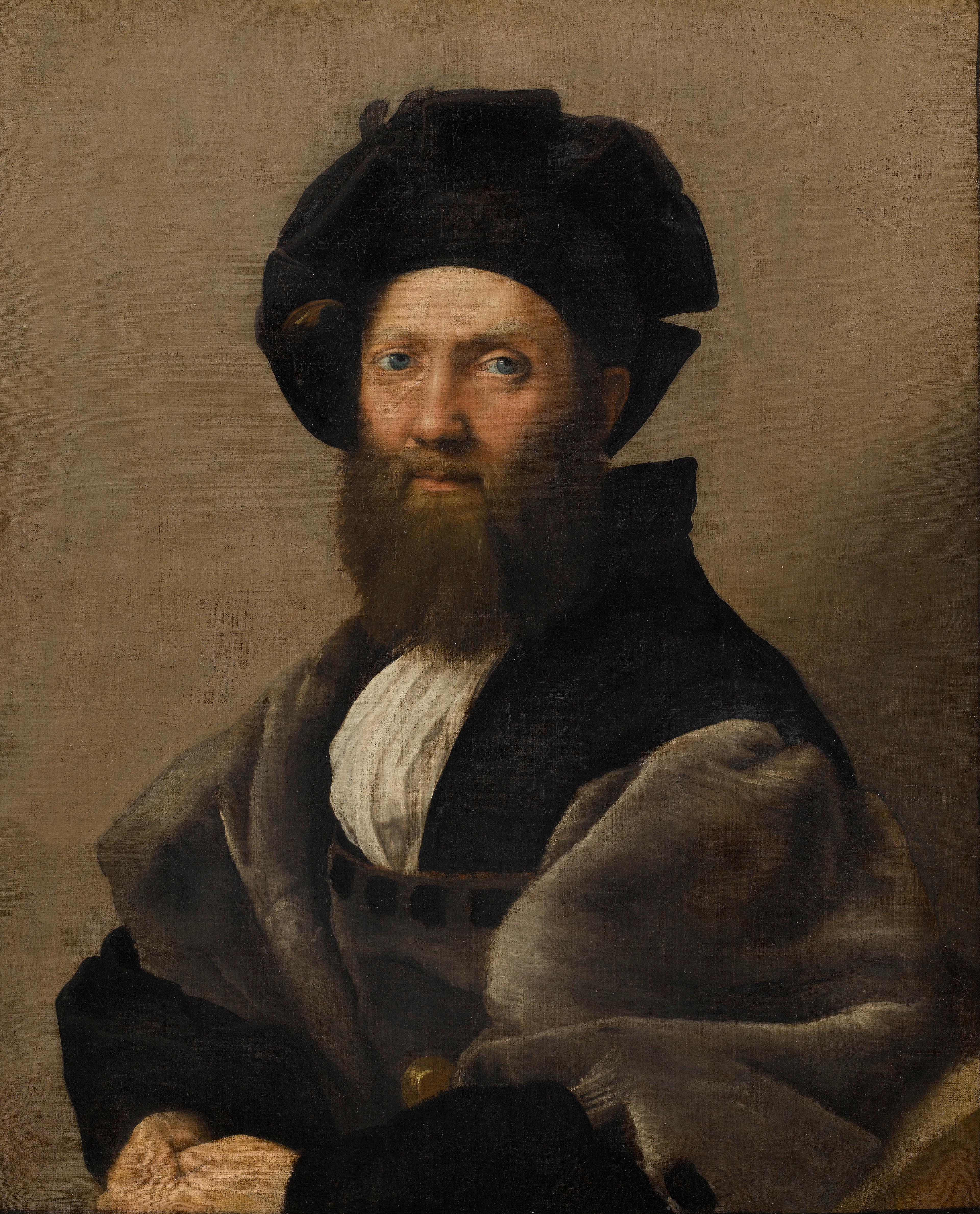
Raphael (Raffaello di Giovanni Santi; 1483–1520). Portrait of Baldassarre Castiglione, 1514–16. Oil on canvas, 32 5/16 × 26 3/8 in. (82 × 67 cm). Musée du Louvre, Département des Peintures, Paris (611)
After his success in the Stanza della Segnatura, Raphael was tasked with the remaining rooms of the papal apartments and became the most sought-after artist in Rome. Between 1508 and his death in 1520, Raphael was extremely prolific, made possible by his intense work ethic and his operation of a successful studio, where he trained up younger artists who could assist on myriad projects. Another important part of Raphael’s success was his ability to collaborate with others and maintain important friendships, such as with Baldassarre Castiglione (1478–1529), who appears in this vivid portrait. Castiglione was the author of The Book of the Courtier (1528), which detailed the way to behave in a graceful manner; famously, he coined the term sprezzatura (which can be translated as “nonchalance” or “casual elegance”). Raphael’s portrait shows Castiglione as the model of understated courtly elegance, wearing a luxurious yet sober black jacket with sumptuous gray fur sleeves. The stylish black hat completes the outfit and cleverly disguises the writer’s baldness. Along with Castiglione, Raphael’s social circle included influential poets, humanists, artists, and architects in Rome.
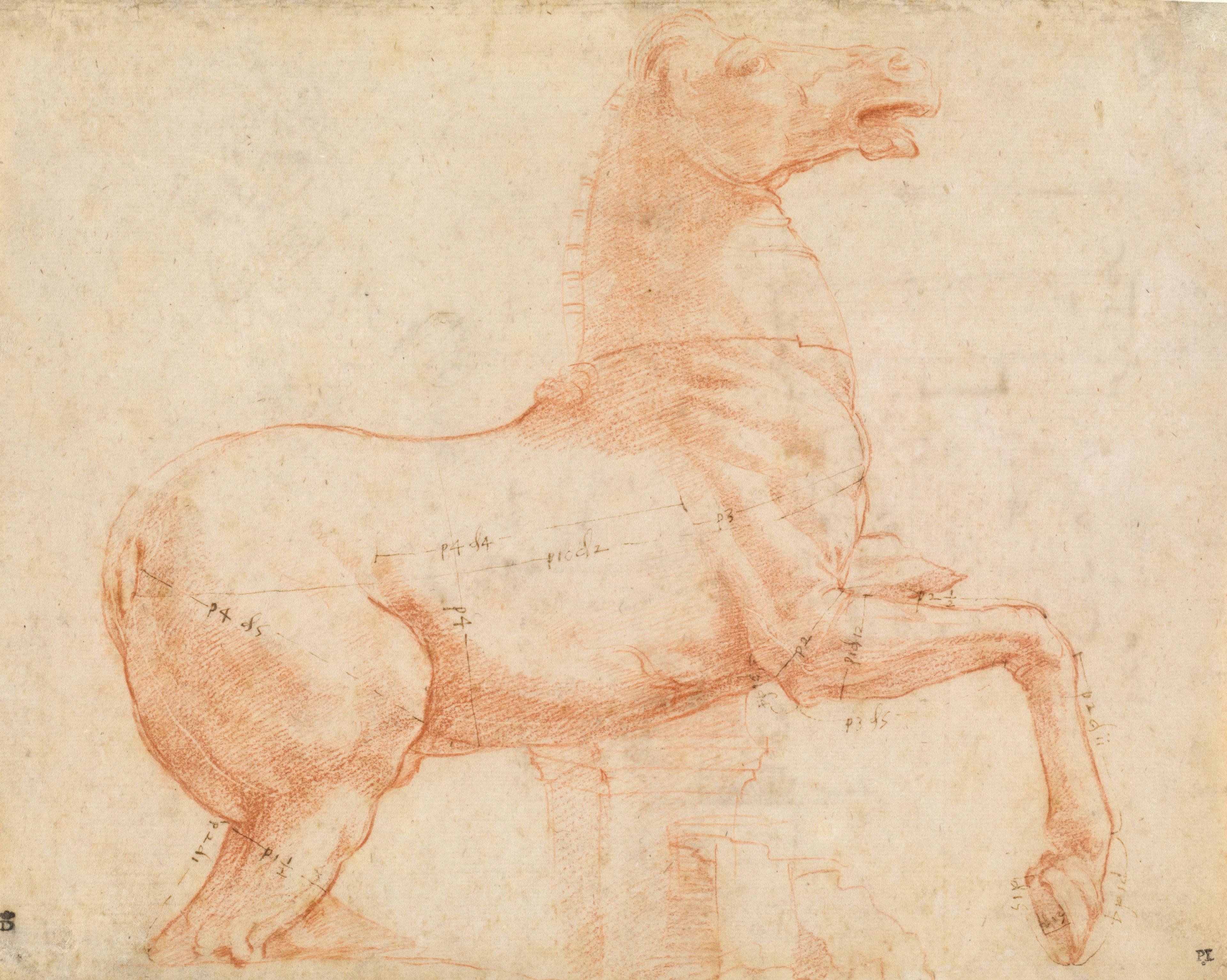
Raphael (Raffaello di Giovanni Santi; 1483–1520). Study of a Marble Horse on the Quirinal Hill (“opvs praxitelis”), ca. 1515–16. Red chalk, over leadpoint and stylus underdrawing, with annotations in pen and brown ink, on laid paper, 8 5/8 × 10 13/16 in. (21.9 × 27.4 cm). National Gallery of Art, Washington, D.C. (1993.51.3.a)
No matter how many projects Raphael may have been working on, he seemed to have had endless ambition and thirst for knowledge. Along with the many artistic projects underway in the final decade of his life, Raphael also began to cultivate a serious interest in architecture, and in 1514, he became the lead architect on the Basilica of Saint Peter’s in Rome, following in the footsteps of his mentor, Donato Bramante (1444–1514). As part of his architectural interests, Raphael was fascinated with the legacy of ancient Rome. This rare surviving drawing, of a horse from the famous ancient Roman sculpture the Quirinal Dioscuri (Quirinal Horse Tamers), shows how closely Raphael recorded existing monuments. At his death, he was in the midst of an ambitious survey of the ancient city.
After eight days of fever, Raphael died on April 6, 1520, his thirty-seventh birthday. His biographer, Giorgio Vasari (1511–1574), attributed his death to exhaustion from the time he spent pursuing his love affairs. However, the enormous output in the last years of his life points to another probable source of his fatigue, which was likely coupled with misdiagnosis due to the limits of Renaissance medical care. He was buried with great ceremony in the Pantheon in Rome, and his legacy would live on through his works and his students for centuries to come.
This essay is published in conjunction with the exhibition Raphael: Sublime Poetry, on view through June 28, 2026.


