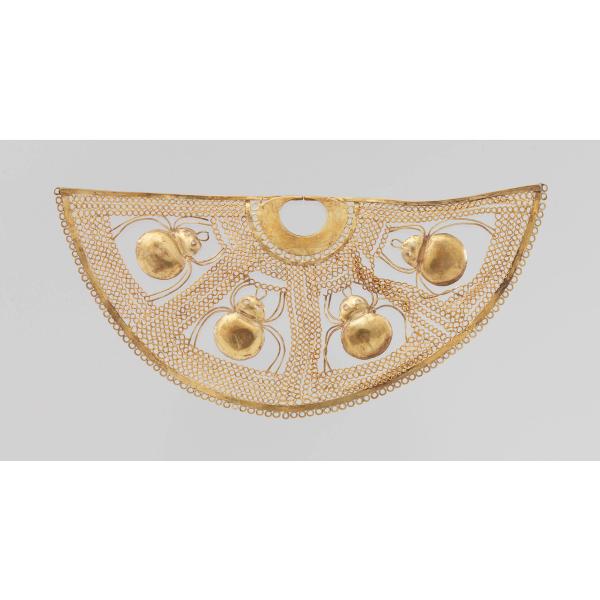
Nose Ornament with Spiders
Spider imagery appears in Andean works of art from the middle of the first millennium BCE until the Spanish Conquest in the sixteenth century. Spiders were particularly important within the cosmology of Peru’s North Coast for their ability to catch and kill live prey, a skill that linked them to warfare and ritual sacrifice. The Moche, who flourished in this region from 200–850 CE and who are thought to be the cultural successors to (if not the direct descendants of) the Salinar, may have even seen the spider’s practice of ensnaring its victim in a web and draining vital fluids as analogous to the way a warrior captured an enemy with ropes and extracted blood. In the North Coast, spiders were further understood to be harbingers of agricultural fertility, as they often appeared before rainfall, an important life-sustaining resource in the arid, desert-like environments of coastal Peru.
Nose ornaments, worn suspended from the nasal septum and often covering the mouth and lower face, were made for high-status individuals. These and other body adornments were likely used in the ancient Americas as material expressions of position and power. Frequently found on or near an interred individual as salient features of elite burials, such ornaments were also thought to identify the status of the interred in the afterlife, distinguishing the wearer even in death.
Technical Analysis
Deborah Schorsch, Objects Conservator at The Metropolitan Museum of Art, notes that Salinar ornaments are frequently characterized by a generous and innovative use of wire, a predilection for soldered rather than mechanical joins, and a preference for minimally volumetric forms. Schorsch’s studies of this nose ornament have further revealed that the spiders’ reductive bodies were cut out from gold sheet that was slightly bowed to indicate the abdomen and cephalothorax (fused head and thorax). The eyes have been perforated from the underside and the burrs polished to create flattened rims. Two square-section wires were joined side by side with solder and to the underside of the spiders’ bodies to form eight legs; two additional square wires were soldered to the underside of each head to create the pincers. The curlicue webs were fashioned from multiple pairs of round wires that were hammered and/or abraded flat on the front and back, especially where they overlap, and then soldered together. Hammered sheets or strips and flattened round wires form additional elements.
References
Alva Meneses, Néstor Ignacio. 2008. “Spiders and Spider Decapitators in Moche Iconography: Identification from the Contexts of Sipán, Antecedents, and Symbolism.” In The Art and Archeology of the Moche: An Ancient Andean Society of the Peruvian North Coast, edited by Steve Bourget and Kimberly L. Jones, 247-261. Austin: University of Texas Press.
Alva, Walter, and Christopher B. Donnan. 1993. Royal Tombs of Sipán. Los Angeles: Fowler Museum of Cultural History, University of California.
Cordy-Collins, Alana. 1992. “Archaism or Continuing Tradition: The Decapitator Theme in Cupisnique and Moche Iconography.” Latin American Antiquity 3 (3): 206-20.
King, Heidi. 2002. “Gold in Ancient America.” The Metropolitan Museum of Art Bulletin 59, no. 4 (Spring): 5-55. http://www.jstor.org/stable/3269153.
Pillsbury, Joanne, Timothy Potts, and Kim N. Richter, eds. 2017. Golden Kingdoms: Luxury Arts in the Ancient Americas. Los Angeles: The J. Paul Getty Museum and The Getty Research Institute. Cat. no. 19, p. 145.
Seo, Ji Mary. 2018. "How to Wear Body Ornaments from the Ancient Americas." In #MetKids Blog. New York: The Metropolitan Museum of Art. https://www.metmuseum.org/blogs/metkids/2018/how-to-wear-body-ornaments-from-the-ancient-americas.
Artwork Details
- Title: Nose Ornament with Spiders
- Date: 100 BCE–200 CE
- Geography: Peru, North Coast
- Culture: Salinar
- Medium: Gold
- Dimensions: H. 2 x W. 4 3/8 x D. 1/8 in. (5.1 x 11.1 x 0.3 cm)
- Classification: Metal-Ornaments
- Credit Line: The Michael C. Rockefeller Memorial Collection, Bequest of Nelson A. Rockefeller, 1979
- Object Number: 1979.206.1172
- Curatorial Department: The Michael C. Rockefeller Wing
Audio
1647. Nariguera, artistas salinar
Luisa Vetter y Gabriel Prieto
LUISA VETTER: Estamos observando una nariguera de forma semi lunar en donde vemos cuatro arañas.
JOSÉ MARÍA YAZPIK (NARRADOR): Luisa Vetter, arqueóloga especializada en metalurgia andina antigua, describe cómo los artistas de la cultura Salinar crearon este exquisito ornamento.
LUISA VETTER: Estas arañas están hechas en base a láminas de metal y las patitas son igualmente hilos de oro. Se ha tejido como tela de araña, justamente por medio de hilos de oro. Estos hilos. Es la técnica de filigrana. Son hilos muy delgados en donde se van uniendo por medio de soldadura. Soldadura que es el uso de fuego de calor para unir dos metales.
JOSÉ MARÍA YAZPIK: En este adorno que se sostenía en el septum perforado del usuario las arañas y sus redes, delicadamente elaboradas, colgaban frente a la boca.
Gabriel Prieto, University of Florida.
GABRIEL PRIETO: Estos ornamentos de oro de la sociedad Salinar claramente han sido utilizados en la vida diaria y cotidiana. En nuestros hallazgos vemos claramente huellas de uso. Vemos algunas rupturas del metal propias del uso.
JOSÉ MARÍA YAZPIK: En la era Salinar, cuando se fabricó este objeto, hubo un punto de inflexión en la historia andina, en el que las comunidades abandonaron tradiciones religiosas centenarias. Sin embargo, la importancia de la araña, con su capacidad para atrapar, matar y recolectar presas, persistió.
GABRIEL PRIETO: Estos ornamentos de oro de la cultura Salinar que se desarrolló entre el 400 y el 200 antes de Cristo en la costa norte peruana. Son muy importantes porque muestra una transición y al mismo tiempo el desarrollo de un periodo muy particular y muy único en la historia prehispánica andina. Es el momento entre el colapso de Chavín, un movimiento religioso previo muy fuerte y luego esta gran civilización conocida como Moche. Es un momento muy dinámico. Es un momento que tiene sus propios procesos.
JOSÉ MARÍA YAZPIK: Dado que la era Salinar carecía de los templos monumentales de siglos anteriores, algunos la han descrito como una época de lenta progresión social. Sin embargo, los descubrimientos de ornamentos de oro como este, en pequeños pueblos, lejos de los típicos centros de poder, sugieren que, de hecho, se estaban gestando importantes cambios sociales. Estos cambios sentaron las bases para el surgimiento de la cultura Moche, siglos más tarde.
More Artwork
Press the down key to skip to the last item.
Related Content
Perspectives
Articles, audio, and video from The Met's online magazine.
Timeline of Art History
Entries and chronologies from The Met's art encyclopedia.
Publications
Books, guides, and catalogues published by The Met.
Research Resources
The Met provides unparalleled resources for research and welcomes an international community of students and scholars. The Met's Open Access API is where creators and researchers can connect to the The Met collection. Open Access data and public domain images are available for unrestricted commercial and noncommercial use without permission or fee.
To request images under copyright and other restrictions, please use this Image Request form.
Feedback
We continue to research and examine historical and cultural context for objects in The Met collection. If you have comments or questions about this object record, please contact us using the form below. The Museum looks forward to receiving your comments.