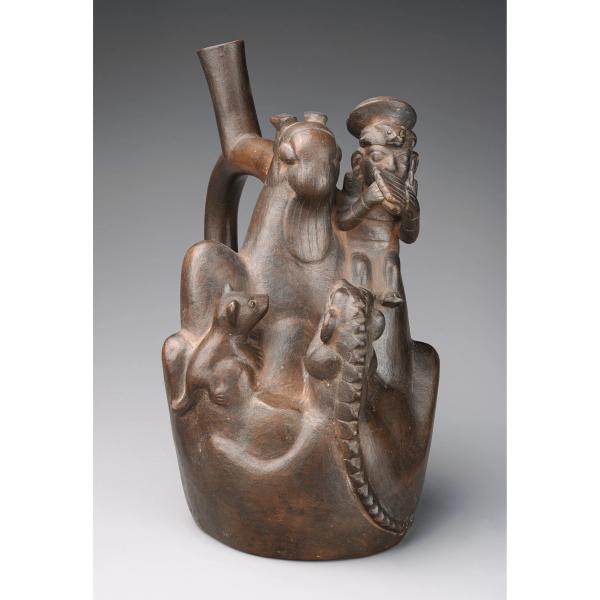
Stirrup-spout bottle with mountain sacrifice scene
On the lower half of the bottle, a feline and an iguana wait expectantly. What events might follow are unknown as the stories behind these images have been lost in the remote past. This elaborate scene, however, may have been part of a complex saga of cultural heroes. Different versions of this theme or depictions of other parts of the story can be seen on other works in the Met’s collection (see MMA 67.167.38 and MMA 65.266.88), as well on vessels in museum collections in Lima, Peru (ML003106 at Museo Larco, and C-03300 at Museo Nacional de Arqueología, Antropología e Historia del Perú).
Archaeologists have emphasized the relationship between mountains, temples, and sacrifice in Moche communities (see, among others, Bourget 2016: 25-30). The remains of a prominent mass sacrifice were uncovered at Huaca de la Luna, the most important ceremonial complex in the Moche Valley during this era. This temple, built at the foot of a mountain, includes an enclosure erected around a rocky outcrop. Archaeological excavations revealed the sacrificed bodies of numerous warriors within layers of dried mud, which was interpreted as evidence that this bloody event occurred during moments of environmental perturbation, specifically the periodic catastrophic rains associated with El Niño (Bourget 2001).
Moche civilization flourished on the North Coast of Peru between 200 and 800 CE. Ceramics were used to store and cook food, and they were also used in some of the most important rituals of their time. Elaborate vessels such as the present example were used in elite residences and temples, some to end up as funerary offerings. The bifurcated spout, called a stirrup-spout after its resemblance to that part of a horse’s saddle, was common on the North Coast from the second millennium B.C. until the arrival of the Spaniards in the sixteenth century CE.
Hugo C. Ikehara-Tsukayama, Senior Research Associate, Arts of the Ancient Americas, 2023
References and Further Reading
Bourget, Steve. Sacrifice, Violence, and Ideology Among the Moche. Austin: University of Texas Press, 2016.
Bourget, Steve. "Rituals of Sacrifice: Its Practice at Huaca de la Luna and Its Representation in Moche Iconography," in Moche Art and Archaeology in Ancient Peru, edited by Joanne Pillsbury, pp. 89-109. Washington, D.C.: National Gallery of Art, 2001.
Castillo, Luis Jaime, Cecilia Pardo, and Julio Rucabado. Moche y sus vecinos: Reconstruyendo identidades. Lima: Museo de Arte de Lima, 2016.
Donnan, Christopher and Donna McClelland. Moche Fineline Painting: Its Evolution and Its Artists. Los Angeles: UCLA Fowler Museum of Cultural History, 1999.
Makowski, Krzysztof. "Las divinidades en la iconografía mochica," in Los dioses del antiguo Perú, edited by Krzysztof Makowski, pp. 137-75. Lima: Banco de Crédito del Perú, 2000.
Uceda Castillo, Ricardo Morales Gamarra, and Elías Mujica Barreda. Huaca de la Luna: Templos y dioses moches. Lima: Fundación Backus, World Monuments Fund Peru, 2016.
Artwork Details
- Title: Stirrup-spout bottle with mountain sacrifice scene
- Artist: Moche artist
- Date: 500–800 CE
- Geography: Peru
- Culture: Moche
- Medium: Ceramic, slip
- Dimensions: H. 8 1/4 × W. 5 × D. 7 1/2 in. (21 × 12.7 × 19.1 cm)
- Classification: Ceramics-Containers
- Credit Line: Gift of Mr. and Mrs. Nathan Cummings, 1964
- Object Number: 64.228.64
- Curatorial Department: The Michael C. Rockefeller Wing
Audio
1646. Botella de asa estribo con escena ritual en la montaña, artista(s) moche
Gabriel Prieto
GABRIEL PRIETO: Los sacrificios humanos en los Andes prehispánicos fueron más comunes de lo que nosotros pensamos. Se han encontrado evidencia desde realidad muchos años antes que los Moches, de hecho. El sacrificio es preparado, planeado y siempre tiene un fin sagrado. Sacrificio viene de la palabra sagrado. Y entonces tiene un propósito, un fin.
JOSÉ MARÍA YAZPIK (NARRADOR): El artista moche que elaboró esta botella vivió en valles desérticos al pie de las montañas costeras del Perú. Esta vasija hace referencia a los sacrificios humanos que los moches realizaban ritualmente, sacrificios que tenían conexiones profundas y complejas con el mundo físico y lo sobrenatural.
Gabriel Prieto, Profesor Asistente de Antropología en la University of Florida.
GABRIEL PRIETO: Esta vasija muestra un momento muy sagrado porque se está tocando una… uno de estos personajes tiene una trompeta de. De un caracol que es conocida como pututo, y entonces este sonido trae un momento especial.
[SONIDO PUTUTO]
JOSÉ MARÍA YAZPIK: Los moches creían que el sonido del pututo abría una conexión con el mundo espiritual.
GABRIEL PRIETO: Se nota que hay un sacrificio humano. Hay un personaje en el pico más alto de la montaña, que está boca abajo y a punto de ser o decapitado o aventado a la parte de abajo de la montaña. Y vemos algunos animales que son típicos de las montañas. Una lagartija como la que vemos en la parte de la derecha, así como los zorros.
[PUTUTO]
JOSÉ MARÍA YAZPIK: Entre los moche, el sacrificio era una práctica religiosa cuidadosamente considerada y profundamente significativa. En 1995, arqueólogos que trabajaban en esta región descubrieron los restos de más de 50 jóvenes, posiblemente guerreros, que habían sido sacrificados de manera violenta y ritual. Algunos cuerpos estaban enterrados en el barro, lo que indica que estos sacrificios ocurrieron en un año lluvioso de "el Niño".
En el desierto costero la lluvia es un evento raro. Sin embargo, cada ciertas décadas, llueve de manera significativa. Los sacerdotes moche pueden haber realizado estos rituales como reacción a estos eventos excepcionales, que podrían resultar en una mator fertilidad, pero también en inundaciones catastróficas y muerte.
GABRIEL PRIETO: El ser humano representa una divinización de representa el sacrificio más supremo que alguien o una sociedad puede hacer. El impacto de un sacrificio humano es un acto muy difícil de de observar y de ser partícipe. Y el hecho que otro humano decida sacrificar, matar a una persona, entonces representa un… un acto muy supremo, algo muy especial, en el cual hay muchos factores que están envueltos.
Al final el sacrificio humano el día de hoy lo experimentamos cuando tenemos familiares que van a las guerras y que estas personas sacrifican su vida por nosotros, por creer en nuestros ideales de libertad, de paz, de desarrollo. Entonces ¿existe hoy en día sacrificio humano? Si existe sacrificio humano y existen diferentes formas de sacrificio humano.
More Artwork
Press the down key to skip to the last item.
Research Resources
The Met provides unparalleled resources for research and welcomes an international community of students and scholars. The Met's Open Access API is where creators and researchers can connect to the The Met collection. Open Access data and public domain images are available for unrestricted commercial and noncommercial use without permission or fee.
To request images under copyright and other restrictions, please use this Image Request form.
Feedback
We continue to research and examine historical and cultural context for objects in The Met collection. If you have comments or questions about this object record, please contact us using the form below. The Museum looks forward to receiving your comments.