Spectrum of Desire: Love, Sex, and Gender in the Middle Ages at The Met Cloisters is an exhibition about the diverse and sometimes quite surprising ways that medieval people thought about love, sex, and gender. It focuses on works of art made between the thirteenth through fifteenth centuries in western Europe, a period when—from a legal perspective—ideas about how to live and whom to love were hardening. As curators, we are interested in the ways that works of art can complicate our understanding of this moment. While they sometimes reinforce this restrictive line of thinking, they can also make way for identities, relationships, and expressions of desire that are far more open and fluid than we would otherwise suspect.
One of the exhibition sections is entitled “Beautiful Bodies,” in which we focus on images of saints and pay close attention to the ways artists represent their gender. It’s in this section that we encounter one of the most intriguing images in the show: a painting of Saint Jerome wearing a woman’s dress.
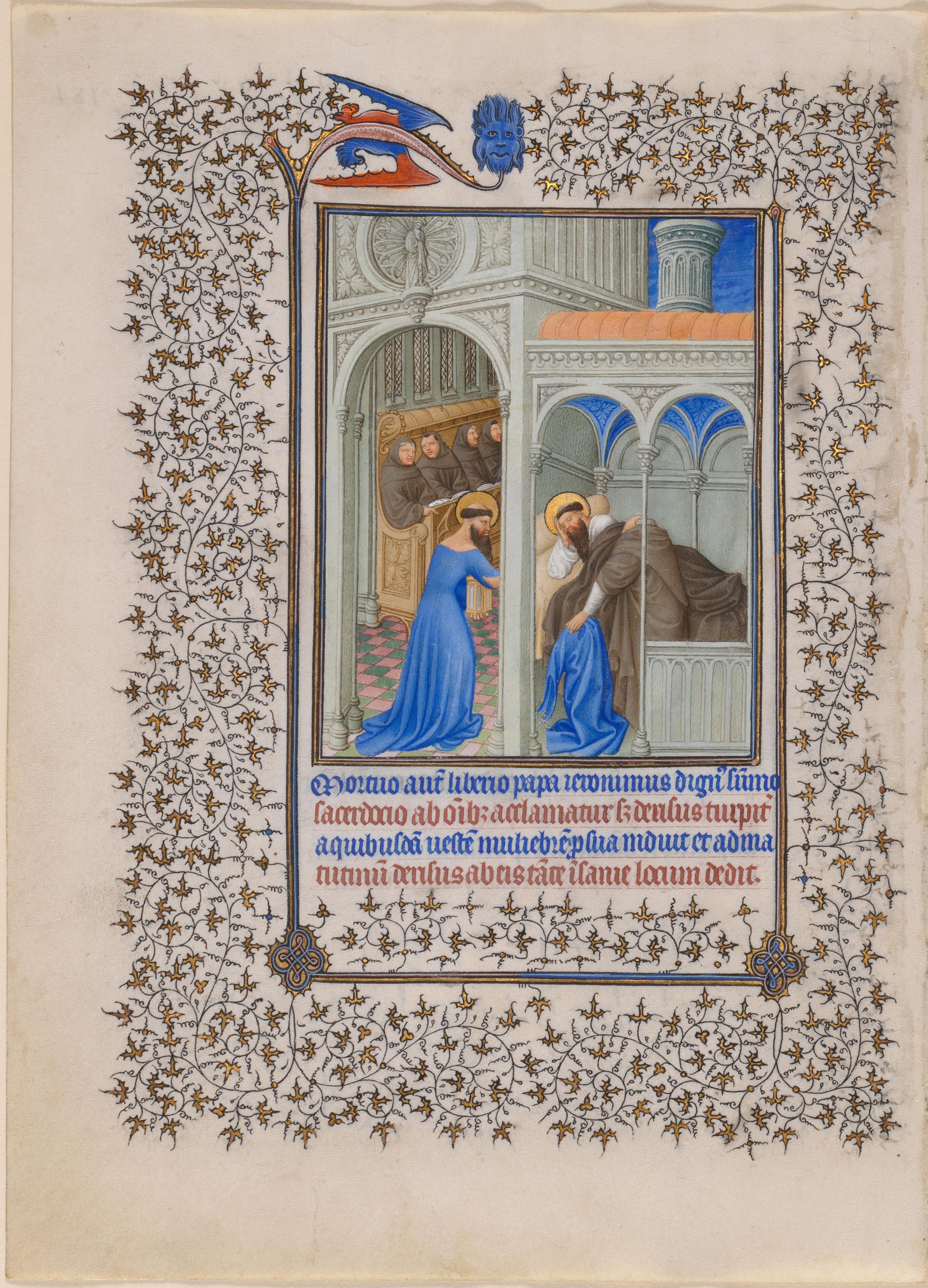
The Limbourg Brothers (Franco-Netherlandish, active by 1399–1416). The Belles Heures of Jean de France, duc de Berry, 1405–1408/1409. Tempera, gold, and ink on vellum, Single leaf, 9 3/8 x 6 3/4 in. (23.8 x 17 cm). The Metropolitan Museum of Art, New York, The Cloisters Collection, 1954 (54.1.1a, b)
We invited Jesse Darling, Ayla Lepine, and Clovis Maillet into conversation to discuss their reactions to this work, having each thought about art and faith in diverse ways, whether from the perspective of an artist, art historian, and/or person of faith. Jesse is a Turner Prize–winning artist and professor at the Ruskin School of Art at the University of Oxford, and he has made several works of art inspired by Saint Jerome which have been widely exhibited, including in the 2018–19 exhibition at Tate Britain, The Ballad of Saint Jerome. Ayla is Associate Rector at the Church of St James Piccadilly in London, an art historian, and author of the forthcoming book, Women, Art, God: Spirituality in the Work of Twelve Artists (2026). Clovis is a performance artist and art historian who has worked extensively on textual and visual representations of gender fluidity in the medieval past; he is the author of both Les Genres fluides: De Jeanne d’Arc aux saintes trans (2020) and an essay in the exhibition catalogue on the very image in question.
Nancy Thebaut:
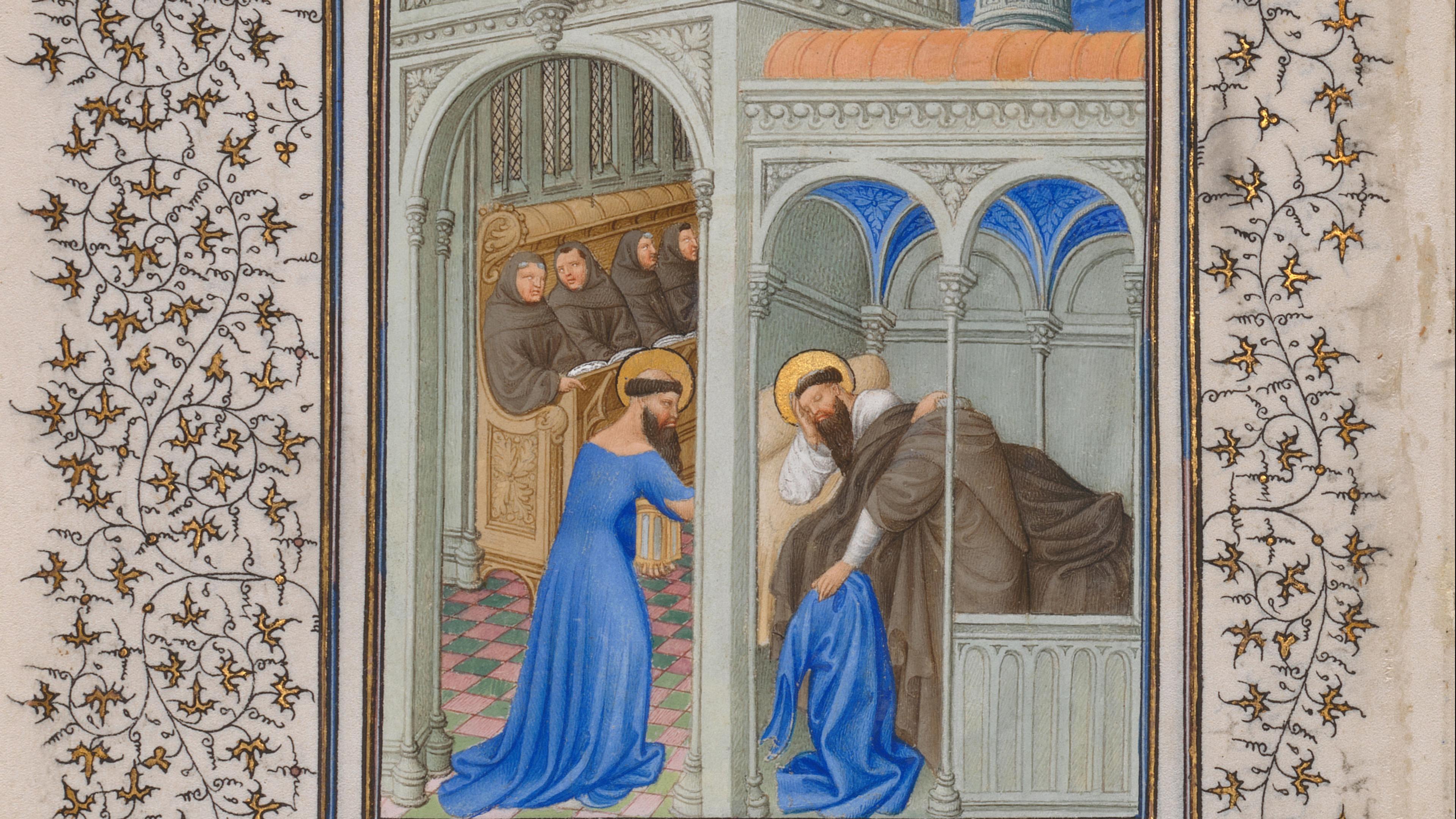
Thank you so much for coming together to talk about one of the more perplexing works in the exhibition Spectrum of Desire. Let’s dive right in. We’re looking at a private prayer book known as a book of hours. It’s quite small—measuring only 23.8 x 17 centimeters—and was painted by the Limbourg Brothers in early fifteenth-century France. It was commissioned by a major collector and patron, Jean de France, duc de Berry, brother of the King of France, Charles V. Inside this prayer book are images that depict moments from the life of Christ and several saints, including Saint Jerome, the Christian theologian most famous for translating the Bible into Latin and who lived between the late fourth and early fifth centuries. This painted page, which we show in the exhibition, depicts a rarely represented story from the saint’s life, specifically a moment when he is staying at a monastery in Rome.
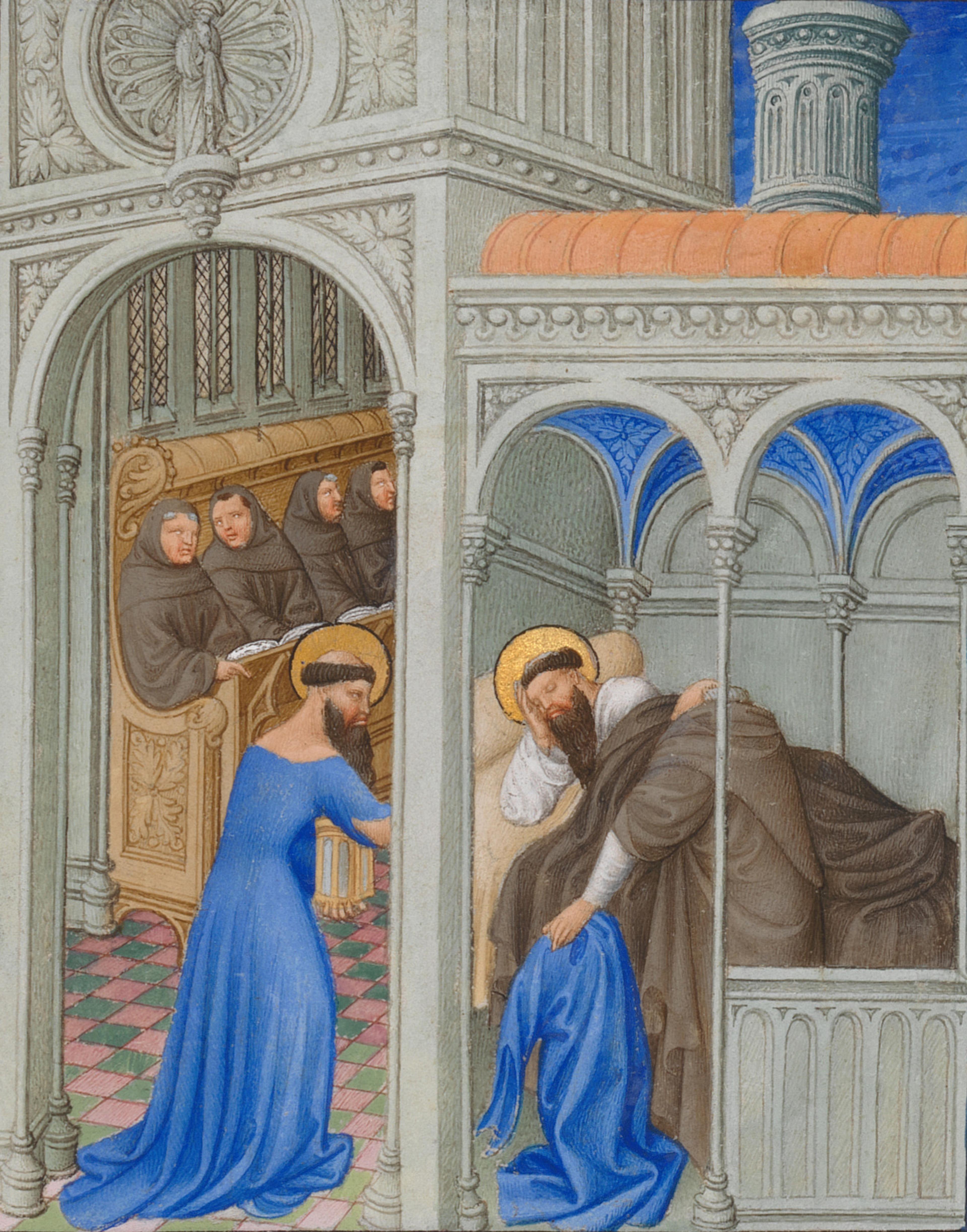
The image is read from right to left: at right, we see the saint sleeping. He is not alone, however: a monk has snuck into Jerome’s chambers and is leaving a blue dress at his bedside. At left, we see that Jerome has put on the woman’s dress: he has presumably woken up for morning prayers, or Matins—when it is still dark outside—and has accidentally put on the form-fitting dress. In the space of the church, we see monks reacting to his appearance; two seem to whisper to one another about Jerome’s unusual outfit. The Latin text below the image tells us that Jerome was shamefully mocked by certain people when he put on women's clothes instead of his own. Specifically, he was “derided” by them, causing him to flee.
There’s a lot going on here, to say the least. I’m eager to hear what your first reactions were to this image, given the unique perspectives you each bring to the conversation: Clovis, you wrote on this image for our catalogue and have worked extensively on gender expression in medieval images of saints; Jesse, you’ve thought a lot about Saint Jerome and made a series of work inspired by his story; Ayla, you’re bringing your perspective as a minister of the Church of England and also an art historian to the image.
Clovis, would you like to begin?
Clovis Maillet:
I first encountered this image in Robert Mills’s book Seeing Sodomy in the Middle Ages (2015) and I just couldn't make sense of it. It was so strange. Mills begins his book with the image, and immediately tells us to be careful of our own modern reactions to the image: while it might seem like an image about drag, or even homosexuality, that’s actually not what it is about.
Thebaut:
Right, Mills insists that gender transgression is actually an attack on Jerome's chastity.
In the story of Saint Jerome’s life in The Golden Legend, a widely circulated compendium of saints’ stories in the Middle Ages, the narrator explains why the monks tricked Jerome into wearing a woman's dress: “The monks used a woman's clothing to create a false impression of him. He got up one morning to go to Matins, as was his custom, and found at his bedside a woman's gown, which, thinking it was his own, he put on and so proceeded into the church. His adversaries, of course, had done this in order to make it look as if he had a woman in his room.”
In other words, the monks are trying to make it look like Jerome slept with a woman, which would be particularly awful for someone who wrote so much on the merits of virginity and chastity.
Jesse, you’ve spent a lot of time thinking about the person behind these stories.
He is a very complicated figure, who may or may not have been so virginal.
Jesse Darling:
During my Jerome obsession, I did a lot of research on the actual guy. While Jerome was a popular figure in society, he did get in trouble on occasion: in one instance, he prescribed one of his female followers—a popular party girl, if you will—such intense ascetic penance that it killed her. Everyone was pissed. People responded by saying: “He's too harsh; he went too hard.” He was run out of town. Maybe that's where Jerome begins his exile.
During his exile, one of his followers, a wealthy widow named Paula, set him up with a library and a new spot. And while women didn’t lead services or weren’t seen as spiritual teachers then, she taught alongside him. Paula was, it seems, a charismatic and popular speaker. There was a lot of speculation about their relationship.
So all kinds of things could have made Jerome a target. He is a very complicated figure, who may or may not have been so virginal. In his diaries, he's talking to his fellow monks, saying he wants to again kiss them on the lips, and so on. We really don't know.
Ayla Lepine:
When I first looked at the right side of the image, it took me a while to distinguish between the blanket on Jerome’s bed and the habit, or clothing, of the monk who has snuck into his room. It seems so inappropriately invasive. We don't even see this monk’s facial expression, and no doubt there is a sense of ambiguous intent.
Darling:
Yes, invasion or intimacy.
Lepine:
I’m interested in how virginity and biblical narratives might be at work here. Looking again at this blue dress, I'm wondering if someone turning the page might say: “Wait a minute, doesn't that look a bit like the form of two figures in an Annunciation? Is there a connection between blue, chastity, birth, and Mary the Mother of God here?” I see the image of Jerome in the blue dress on the left as a Gabriel-like manifestation. The dress held without a body in it (on the right) could be a visual cue to imagine the kneeling body of the Blessed Virgin Mary receiving her announcement from the Angel on behalf of God. Hail Mary becomes a highly complex “Hail, Jerome.” With this overlay from the Annunciation in Luke’s Gospel in mind, the blue garment could express Jerome's own devotion not only to Mary and to the Incarnation and to following Christ, but also to virginity and chastity as a key aspect of monasticism. A joke becomes an opportunity for unexpected prayer. Jerome, in this way, inhabits queer theology connecting him to Mary and an androgynous archangel. This reading might provide a visual counternarrative to the dress as a method to undermine his dignity and make him a subject of ridicule.
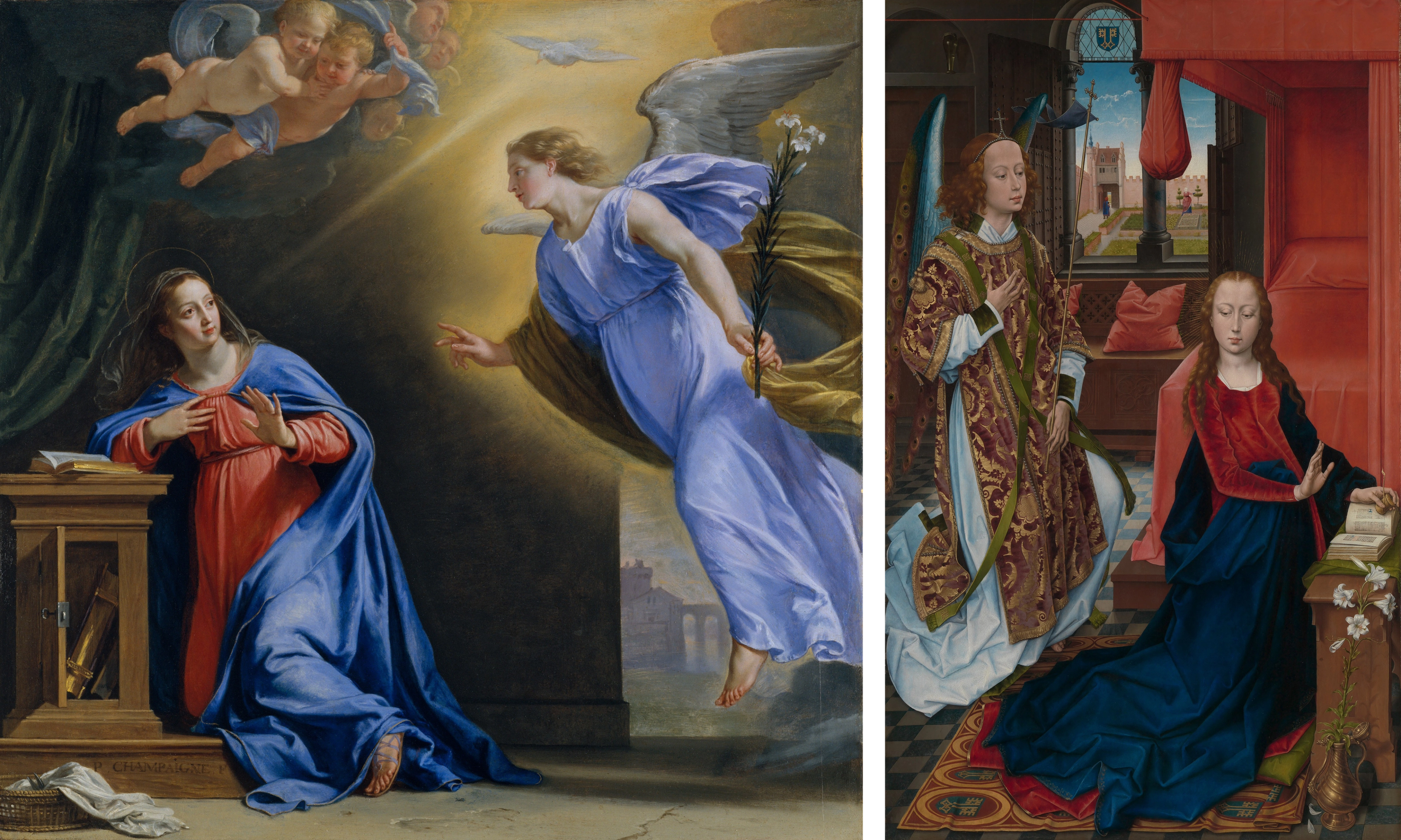
Left: Hans Memling (Netherlandish, active by 1465–1494). The Annunciation, ca. 1465–70. Oil on wood, 73 1/4 x 45 1/4 in. (186.1 x 114.9 cm). The Metropolitan Museum of Art, New York, Gift of J. Pierpont Morgan, 1917 (17.190.7). Right: Philippe de Champaigne (French, 1602–1674). The Annunciation, ca. 1644. Oil on oak, Overall, 28 x 28 3/4 in. (71.1 x 73 cm); painted surface, 27 1/4 x 27 3/4 in. (69.2 x 70.5 cm). The Metropolitan Museum of Art, New York, Wrightsman Fund, 2004 (2004.31)
Darling:
I'm with you. And the Virgin is often depicted in blue in medieval art and thereafter.
Nancy:
That's really interesting; I hadn't thought about the Annunciation in relation to this image before. I think the viewer likely also made an association with another blue dress in the manuscript, specifically one worn by a woman “tempting” Saint Jerome on a different folio.
Jesse:
The thing that strikes me is not so much Jerome's feminine aspect in the dress—although it's this racy low neckline that makes it kind of femme—but rather, it’s his beard. Jerome is often (indeed possibly always) depicted with a beard. In this image, he's the only one who isn't clean shaven. The beard is one of the key ways you know that Jerome is a man, making the dress incongruent.
But let’s think about clothing in other parts of the image, too. Take, for instance, the monks in the background. We know that they're (spiritual) brothers. But actually… how do we know? In a lot of medieval art, it can be difficult to distinguish gender: you sometimes have to squint to tell whether someone is supposed to be a man or a woman. The monks themselves have this androgynous aspect. They're in these robes with shawls that women also walked around in. All of their garments can feel somewhat ungendered to us today.
Thebaut:
Clovis, in your catalogue essay, you invite us to think about the history of fashion as central to understanding what's going on in the image.
Maillet:
The tiny details are what really captured my attention. If you look at Jerome's right elbow, you can see his flesh. I compared this dress to all the other dresses in this manuscript and none of them show the elbow in this way. It’s really unusual, and indeed, a few fashion historians informed me that no medieval dress, in fact, would purposely show the flesh of the arm.
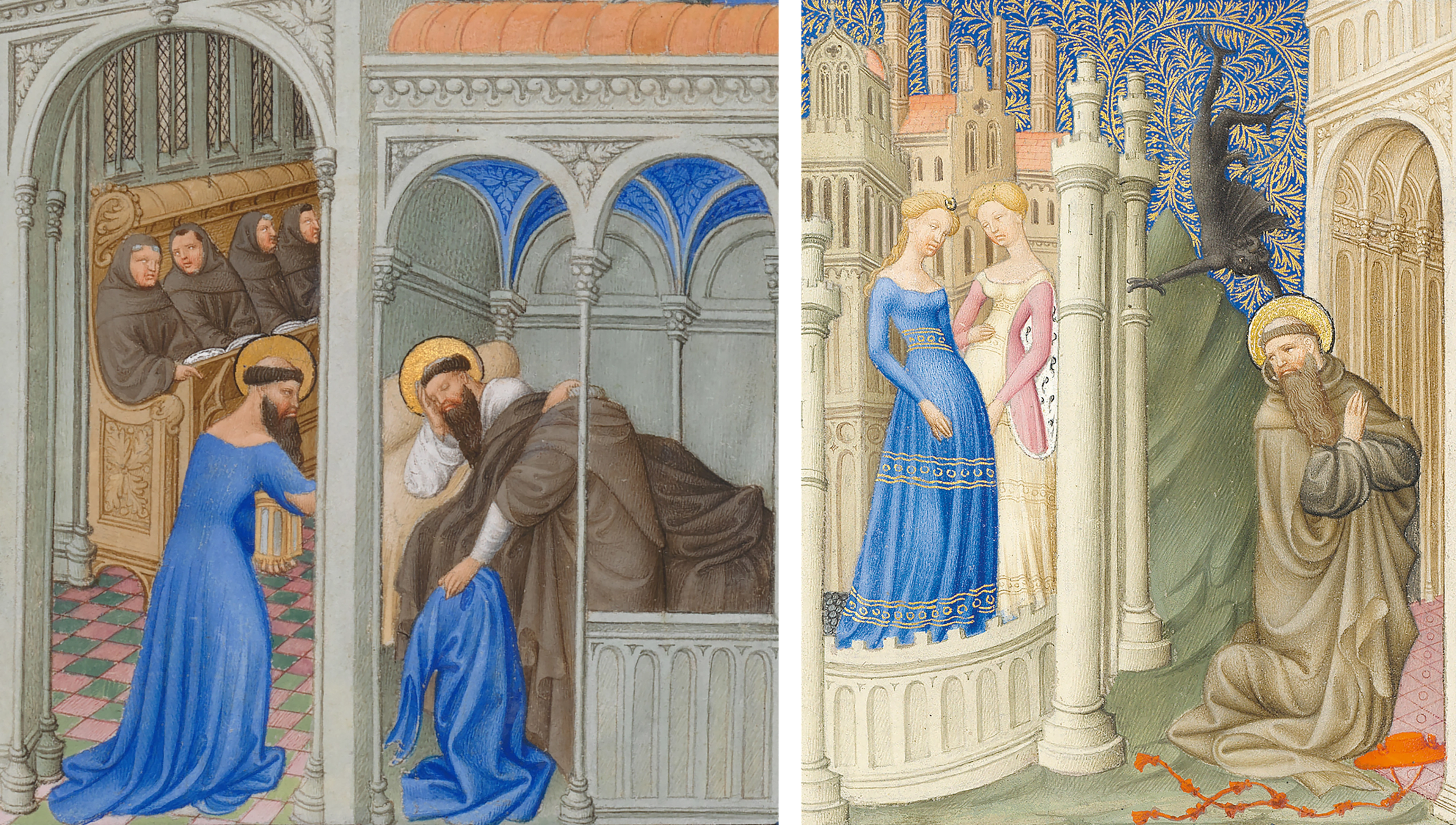
Left: The Belles Heures of Jean de France, duc de Berry (detail). Right: Saint Jerome facing temptation. The Belles Heures of Jean de France, duc de Berry (detail)
My hypothesis is that what we’re looking at is actually not really a dress, per se, or even a full piece of clothing meant to be worn in public. Rather, it’s a particular kind of garment always worn layered between other pieces under and on top of it. So he's not really fully dressed as a woman, but rather only wears one part of a woman’s clothing. We tend to focus now on the gender expression of Jerome, but for viewers in the fifteenth century, perhaps what would have been shocking is to see the father of the church in underwear!
Darling:
It's like showing up to dinner in your boxers. It's really kind of embarrassing, especially for a Church Father.
Lepine:
Jesus tells a story about clothing and humiliation, and I can see Jerome’s dress as a parallel reference here. In the biblical story, Jesus suggests that the Kingdom of God is like a banquet hosted by a wealthy (and as it turns out, murderous) ruler—the host need not be interpreted as God and really shouldn’t be. Lots of people are invited, and they all refuse to attend. Eventually, a guest turns up in the wrong clothes, and this leads to a horrific exile experience.
A view on this that might resonate with this Jerome is that, after so many attempts to lure people into what looks like a feast but is actually a manifestation of violent power, the person who chooses to come as they are, showing up in whatever clothing they’ve got, is still making a choice to attend on their own terms. The story’s focus on clothing is a way of questioning the dynamics of host, guest, and who’s got the power. Jerome is singled out partially because he is attracting attention from powerful folks elsewhere in the Church. The community may be re-clothing him in a temporary transgressive garment, but ultimately it’s their own deviousness and sinful cruelty that comes to light. Jerome gets to choose how he reacts to them. Could he have worn this dress with pride, not really caring about what others think, while exposing the motivations of his monastic brothers at the liturgy? It could have been pretty painful to sing psalms about God’s love and mercy having just played a mean trick on their fellow-brother. If they were pleased with themselves even while they were praying, then they have forgotten how important it is to love one another, which is a commandment from God too.
What would have been perceived as shame is worn as a reminder of every person’s capacity to humiliate and dehumanize one another and to reject God.
Relatedly, the externalisation of suffering and rejection—including “wrong” clothing—makes a link between Jerome and the Passion. There is a clothing swap that performs the horror of rejection. Christ wore a garment woven without a seam. It was very high quality. His oppressors gambled for it. Someone won the cloak, even as they condemned and hated its owner. His cloak was swapped for an ironic purple robe—purple being a materially and socially deluxe color, the color of emperors and rulers. Here, it is—like Jerome’s blue dress—associated with public shame. It is the “wrong dress,” like Jerome’s experience of a swapped garment. This is why Christians use purple in Lent—as a priest, I too wear a purple silk chasuble during this season. When I put it on, I remember this story. Now I’ll think of Jerome’s blue dress as well. This color, its meaning inverted and then reclaimed, is a queer embrace of an ironic sign. The garment Jesus was forced to wear because of its irony is a color of revolutionary, vulnerable love. What would have been perceived as shame is worn as a reminder of every person’s capacity to humiliate and dehumanize one another and to reject God. Jerome’s blue dress, through this lens, is an item meant to humiliate, but it can be worn as a proud emblem of sacred and vulnerable humanity.
Thebaut:
I’d like to look at a different artist's representation of this particular narrative from a manuscript at the Vatican. It’s one of the only other images I can find from the medieval period of this moment. The inscription in Latin says: “How he put on a woman's dress and woke up for Matins.”
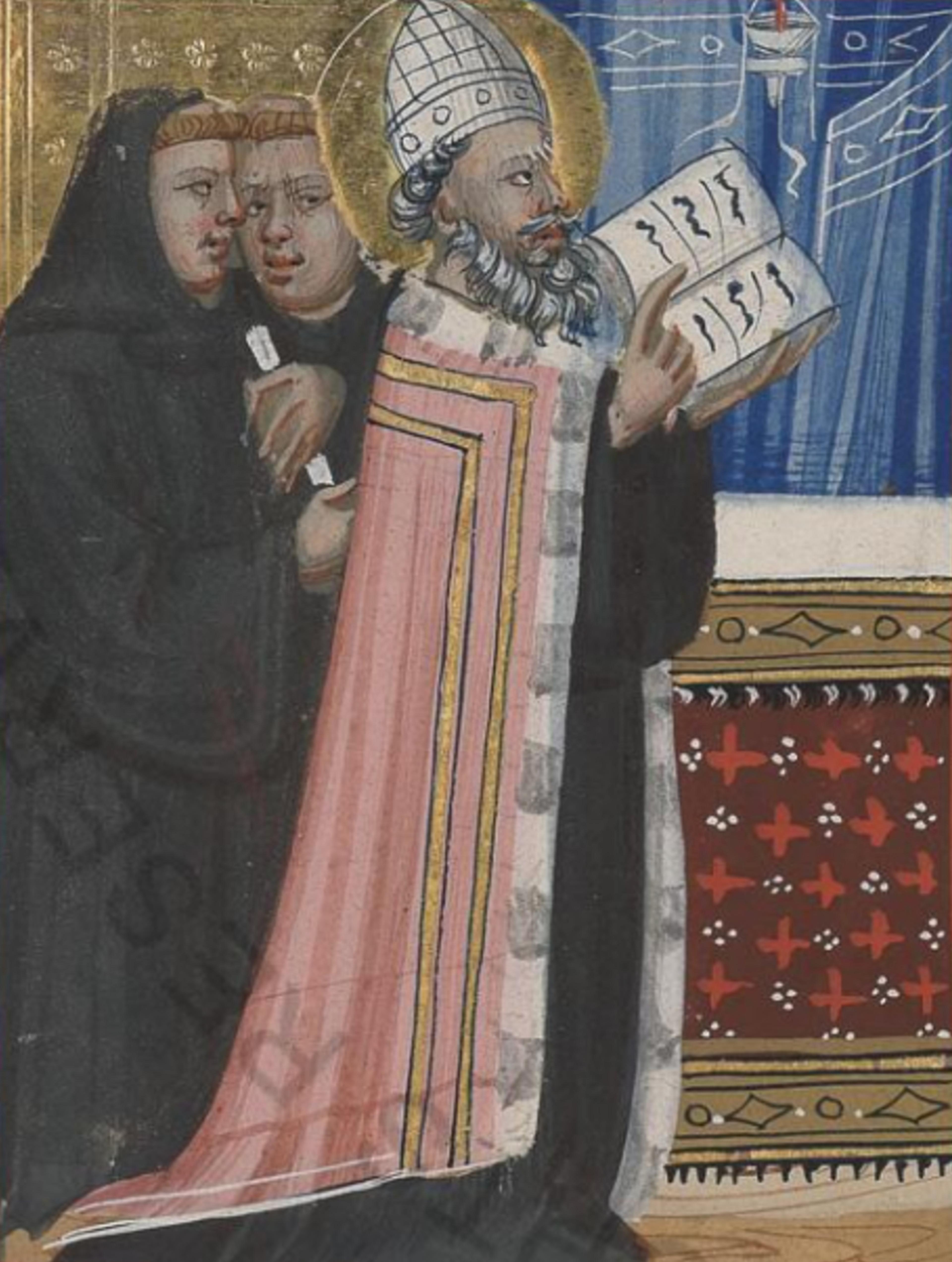
Saint Jerome. Vatican Library Lat. 8541, folio 76r ,1325-1335. Made in Bologna, Italy, or Hungary. Parchment, 28 x 21.4 cm. Image © Biblioteca Apostolica Vaticana
Maillet:
What is very similar is the gossiping of the monks in the back. You can see they're talking about him. But we can’t really see the details of the dress. It could be a more historical way of depicting women and men’s dresses. In the fourth century, there wasn’t really a difference between male and female clothes. It wouldn't be as visible as in the Belles Heures image, which is really playing on the fact that at the beginning of the fifteenth century, you could distinguish female and male clothes at first sight.
There’s a record of a trans monk from the fourth century, Matrona of Perge. We don’t have any images, but their hagiography, The Life of St. Matrona of Perge, says that to look like a man, they would just readjust their dress to make it look like a man’s dress. Adding a belt and covering the head, for example, would be sufficient to pass as a man.
Lepine:
Being careful not to read the modern backward from the point of view of ecclesiastical textiles and vestments, I'm wondering what it would look like for Jerome to be tricked. If this is a representation of women's clothing—and it's meant to be for Matins—what we seem to be seeing, in an awkward and not quite liturgically legible way with the lamp and this strange quasi-altar, is not Matins at all. No one goes to Matins in a cope and mitre. These are recognizable as certain kinds of vestments and expected ecclesiastical dress, and also, in a sense, it’s all wrong.
Thebaut:
When I first encountered this image, I wondered if the artist of the Vatican painting—unlike the Limbourg Brothers—was perhaps uncomfortable representing Jerome in a woman's dress, which could explain the very different approach. Here, nothing about Jerome is legibly feminine. Instead, we have a vestment that is pink, gold, and perhaps with a black-and-white fur trim. Rather than depicting Jerome’s clothing as feminine, the artist suggests there is something luxurious, and thus inappropriate, about his garment. The image makes me think more generally about how artists grapple with narratives that might be uncomfortable for them.
Artists, like everyone else, are informed by what’s happening in their own historic moment. Artistic decisions sometimes say more about that moment and its moral panics than anything depicted in the work.
Darling:
Artists, like everyone else, are informed by what’s happening in their own historic moment. Artistic decisions sometimes say more about that moment and its moral panics than anything depicted in the work. But I do keep wondering about the real Jerome. About whether somebody who hadn’t set himself up as this hyper-virtuous, ascetic paradigm would’ve been targeted by a public prank in the same way. Whatever really happened, it seems that Jerome was totally cancelled in his day and subsequently hounded to madness. My contemporary reading of the historical Jerome is that this prank might be less about the specifics of garments and gender. It’s not really possible, anyway, to map contemporary understandings of gender onto the medieval past. Whatever’s going on in this picture, you can see that what he’s wearing appears noteworthy—whether he appears disastrously self-absorbed or whether it’s because he hasn’t noticed he’s half-naked or dressed like a girl. Maybe that obliviousness is the point, and not the woman’s garment in particular.
But perhaps it’s a sign of utmost piety: he's so inside of something that he doesn't even care what he's wearing.
Maillet:
Yes, in a way, wearing an “unsuitable garment”—whether represented as a fur-trimmed vestment or a woman’s blue underwear—could be read as positive. It could show how little interest Jerome had in being well-dressed. This manuscript is produced for Jean de Berry, known for being one of the wealthiest, best-dressed people of the period. All the other contemporary characters in the manuscript are very well-dressed. Not being too well-dressed could be a provocative way of showing modesty. Interestingly, Jerome is also known for attributing morality to the way people dressed. When he went to see Paula and others, he’d ask them to take off their jewelry and to look very plain.
Darling:
Yes, when Jerome the scholar translated the Bible into Latin, effectively mainstreaming it, he is the one who gave us this idea that in the garden, Eve covered her “shame.” That was his particular gloss.
Thebaut:
Clovis, you’ve thought a lot about clothing and sainthood, specifically the ways that many saints change their gender presentation through clothing, mostly from female to male. There are more than thirty examples. We show two such saints in the exhibition, Saints Theodor(a) and Saint Marin(e), who are born female but later cut their hair and put on the (male) monastic habit, ultimately passing as male until their death. How does the story of Saint Jerome relate—or not—to these other saints?
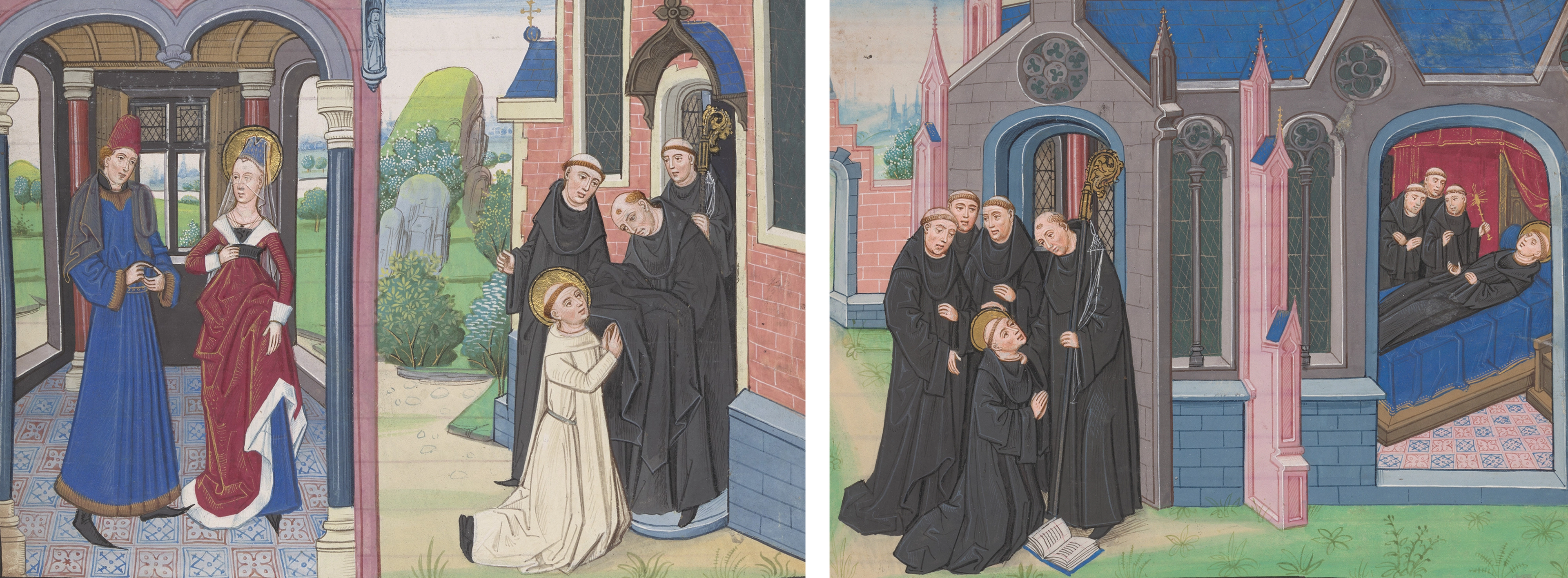
Left: Two images from the life of Saint Theodor(a), first in a dress, then in a monk’s habit. Chronicles II Workshop (Belgian). The Golden Legend, 1445–1565. Folio 310r. Tempera and ink on parchment, 14 15/16 × 10 5/8 in. (37.9 × 27 cm). The Morgan Library & Museum, New York, MS M.674, Purchased by J. Pierpont Morgan. Right: Two images of Saint Marin(e), depicted each time in a monk’s habit. The Golden Legend. Folio 279v
Maillet:
Jerome lives in a time when what we could call trans monks were probably a reality. The Council of Gangra (circa 350) explicitly asked women to stop leaving their husbands, cutting their hair, and living as monks. A number of hagiographies tell the stories of trans monks—Theodor(a), Marin(e), Eugeni(a/us)—who pursued asceticism, living as men. In a letter from Jerome’s Commentaries on Ephesians, he said that a woman who devotes herself to Christ would “cease to be a woman and will be called man.” This comment, that could be read as misogynistic, could also be a comment on the multiplicity of trans people found among hermits at that time.
There is no symmetry, however, between trans femininity and trans masculinity during this period. Jerome’s cross-gendering is brief and cannot be compared to figures described as having lived their entire lives as trans individuals. When the Limbourg Brothers painted this Jerome ten centuries later, trans monks were still very much present in the The Golden Legend, the source material for the Belles Heures, yet stories of crossing gender boundaries are treated in a playful and witty manner.
Thebaut:
I want to end by inviting us all to look at the work that you’ve done, Jesse, on Saint Jerome. I’m thinking specifically of the work that was part of Art Now: Jesse Darling: The Ballad of Saint Jerome at Tate Britain in 2018 and a series of work you made for Artforum the same year. Who is Saint Jerome for you here?
Darling:
I used to think Jerome and the lion was a beautiful gay love story about being seen in your woundedness: “I'm not bad, I'm just hurt.” Jerome healed the angry lion, and the lion came to live with Jerome in his library, instantly tame.
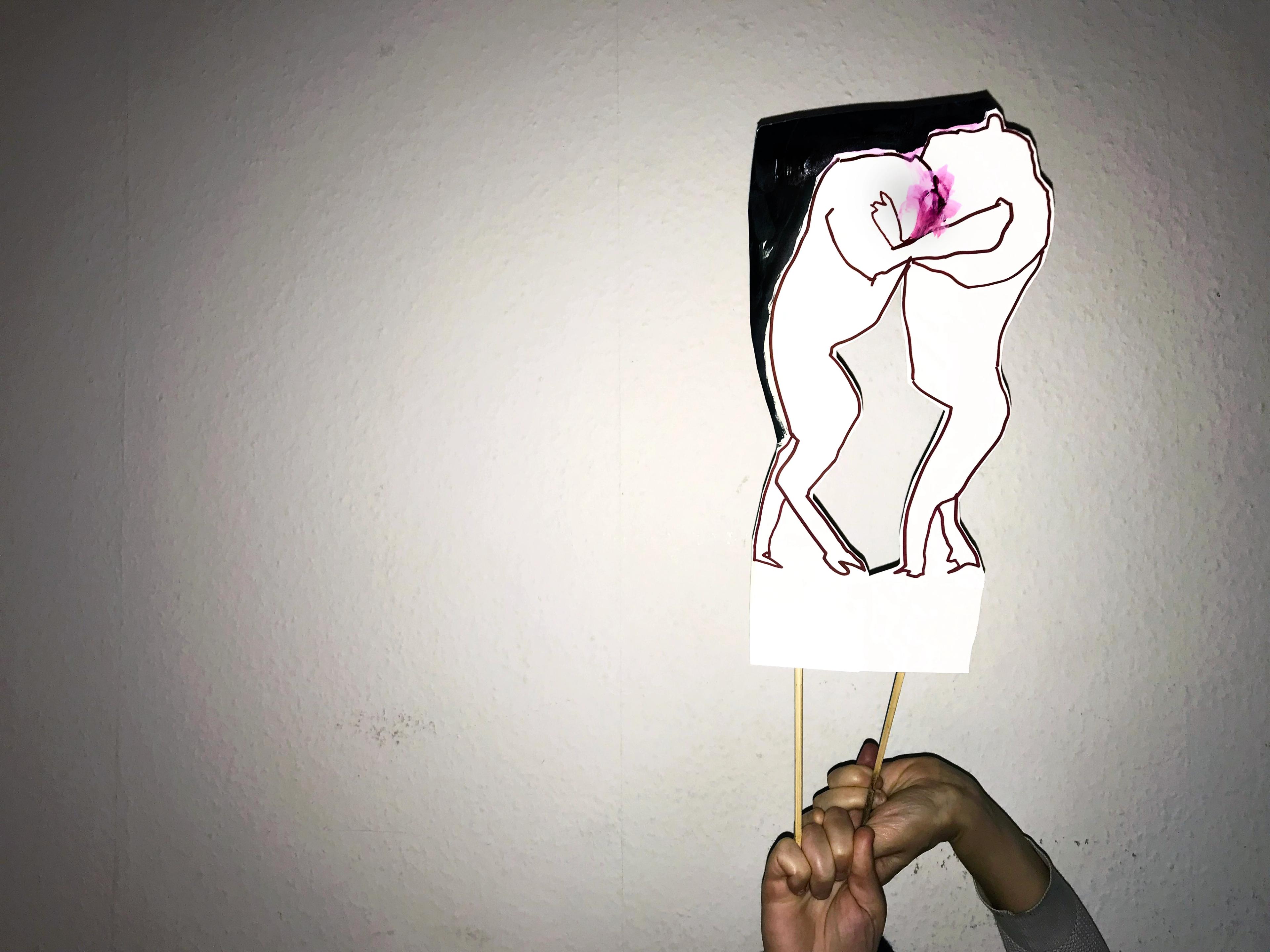
Jesse Darling, No More Saint Jeromes, 2018, ink on paper, chopsticks, tape
Then I became a patient in the medical-industrial complex. Dealing with doctors all the time, you're not understood as a person but as a cluster of symptoms that can be imaged and described but never really witnessed. I had a lot of questions about care and surveillance after that. Care, under the sign of dominance, often looks like surveillance, control, and the hegemon’s supposed greater knowledge of the other.
And so I started wondering: What the hell is a lion doing in a library? I wondered about this relationship of healing and repair. What did the lion have to give up to become domesticated by the scholar-patriarch? There’s also a series of drawings of two lions making out called No More St. Jeromes (2018). Without this guy, perhaps the lions could just be lions, wounded or not. I began to understand the story very differently.
Thebaut:
I love how intensely you first connected with the story and then were almost repelled, it seems, by aspects of it. It’s like the story offered solace and then prompted critical thinking when faced with your own illness. It’s a reminder of how any of the images we’re looking at, contemporary or medieval, can resonate in so many different ways.
Lepine:
I can imagine looking at the Belles Heures image of Saint Jerome with a group of queer Christians in a congregation and asking them: What do you think? Prayer? Queer joy? See how it makes you feel, what it makes you think. There are a million directions to take this in, and that’s a great gift. But it also has its risks, its limitations, and even dangers, especially in our own politically chaotic time.
I'm a fan of “I don't know.” Especially as an educator, as a Christian, and as a priest. It is strangely gorgeous that, in one moment or another, it creates discomfort, unease, or also perhaps delight.
Darling:
All of us have essentially been telling different stories here; there are the stories of Jerome the saint, Jerome the man, and Jerome the translator. And then there's the story of Jerome as he’s depicted in these manuscripts, and the stories of the artists and their own intentions.
I've been somewhat down on Jerome during our conversation, but I was really obsessed with the guy—and his lion—for a long time. It’s the apophatic Jerome that I'm really into, the guy who doesn’t know and who goes seeking. What I appreciate about queer life is that it has this apophatic aspect, like anything goes. Except that it's not “anything goes;” it's more like: Could this be? Could that be? Could it also be both or neither? I don’t trust received assumptions no matter who’s making them. The questions for me are still very important. We really have no idea what any of these things mean, either now or then. And thank God for that—as in, you know, the big guy—or whomever it otherwise may concern.


