Search the collection

Filter By

Object Type / Material
Geographic Location
Department
Date
Show Only:
  • As part of the Met's Open Access policy, you can freely copy, modify and distribute this image, even for commercial purposes.
    APIPublic domain data for this object can also be accessed using the Met's Open Access API
  • Objects with changed or unknown ownership in continental Europe between 1933-1945. Learn more
More than 10,000 results for probably south Lowlands; possibly Bohemia or Saxony
Sort by:
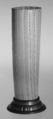
Beaker (Stangenglas), Colorless (slightly gray) and opaque white nonlead glass; pewter mount. Blown, "vetro a retorti"., probably south Lowlands; possibly Bohemia or Saxony
probably south Lowlands; possibly Bohemia or Saxony
late 16th century
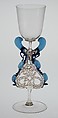
Goblet, Colorless (yellowish), transparent turquoise blue, and opaque brick red, yellow, and white nonlead glass.  Blown, trailed, pincered, "vetro a retorti"., Façon de Venise, probably south Lowlands or Germany
Façon de Venise, probably south Lowlands or Germany
17th century
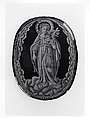
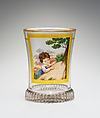
A Female Saint (possibly Rosalia), Colorless nonlead glass. Cut, polished, reverse gilt, painted., probably Bohemia or Lower Austria
probably Bohemia or Lower Austria
second half 18th century
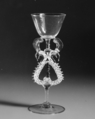
Goblet, Bubbly colorless (very faint gray), opaque white, and transparent turquoise blue nonlead glass. Blown, trailed, pincered, "vetro a retorti"., Northern European (possibly south Lowlands or Germany)
Northern European (possibly south Lowlands or Germany)
probably late 17th century
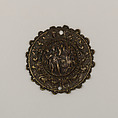
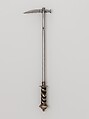
Bit Boss with Adam and Eve, Copper alloy, German, Bohemia or Saxony
German, Bohemia or Saxony
late 16th–17th century
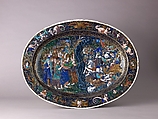
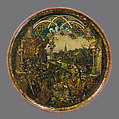
Dish: The Destruction of the Hosts of Pharaoh, Master IC (probably Jean Court) or French, Limoges, Painted enamel on copper, partly gilt.
Master IC (probably Jean Court)
Jean Cour (or Court)
probably early 17th century
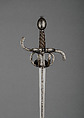
Rapier, Steel, gold, silver, iron, wood, German, possibly Saxony
German, possibly Saxony
ca. 1600
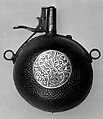
Priming Flask, Wood, steel, silver, German, probably Saxony
German, probably Saxony
late 16th century
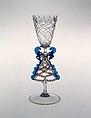
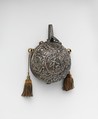
Priming Flask Bearing the Monograms and Arms of the Prince-Elector August I of Saxony (reigned 1553–86) and  Anna of Denmark (reigned 1553–85), Iron, gold, silver, silk, German, probably Saxony
German, probably Saxony
ca. 1575
Goblet, Colorless (slightly gray) transparent turquoise blue, and opaque brick red, white, and yellow nonlead glass. Blown, pattern molded, trailed, pincered, "vetro a retorti"., Façon de Venise, probably south Lowlands or Germany
Façon de Venise, probably south Lowlands or Germany
probably 17th century, possibly 19th century
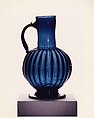
Jug, Transparent dark blue nonlead glass. Blown, pattern molded, trailed., Northern European (probably Bohemia or Germany)
Northern European (probably Bohemia or Germany)
possibly early 16th century; probably late 19th century
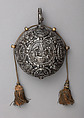
Priming Flask Bearing the Monograms and Arms of the Prince-Elector August I of Saxony (reigned 1553–86) and  Anna of Denmark (reigned 1553–85), Master Thomas der Schwertfeger (possibly Thomas Rucker)  German, Iron, gold, silver, silk, German, probably Saxony
Master Thomas der Schwertfeger (possibly Thomas Rucker)
ca. 1575
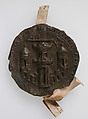
Seal Impression, Saint Peter, Black wax, Netherlandish or South Lowlands (?)
Netherlandish or South Lowlands (?)
ca. 1358
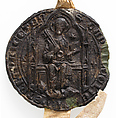
Seal Impression, Saint Margaret, Black wax, Netherlandish or South Lowlands (?)
Netherlandish or South Lowlands (?)
ca. 1358
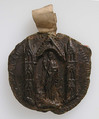
Seal Impression, Coat of Arms, Black wax mounted on paper, Netherlandish or South Lowlands (?)
Netherlandish or South Lowlands (?)
12th–16th century
Seal Impression, Bishop, Brown wax, Netherlandish or South Lowlands (?)
Netherlandish or South Lowlands (?)
ca. 1358
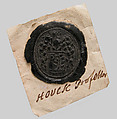
Seal Impression, City Gates, Brown wax, Netherlandish or South Lowlands (?)
Netherlandish or South Lowlands (?)
ca. 1358
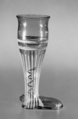
Boot glass, Colorless (gray) and opaque white nonlead glass. Blown, "vetro a retorti", trailed, applied and impressed parts, gilt., Venetian or façon de Venise, probably south Lowlands or Germany
Venetian or façon de Venise, probably south Lowlands or Germany
late 16th or early 17th century
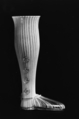
Boot glass, Colorless (slightly tan) and opaque white nonlead glass. Blown, "vetro a retorti", trailed, applied and impressed parts, gilt., Venetian or façon de Venise, probably south Lowlands or Germany
Venetian or façon de Venise, probably south Lowlands or Germany
late 16th or early 17th century
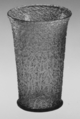
Beaker, Colorless (slightly tan) nonlead glass. Blown, ice-glass technique, trailed, gilt., Italian (Venice) or façon de Venise, probably south Lowlands
Italian (Venice) or façon de Venise, probably south Lowlands
late 16th–early 17th century
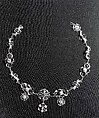
Necklace Formed of Fifteen Dress Ornaments, Gold, enamel, ruby and pearls., probably Transylvanian, possibly South Germany
Transylvania
ca.1600
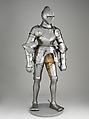
Armor, Steel, leather, German, possibly Lower Saxony
German, possibly Lower Saxony
ca. 1540–50 and later
Armor, Steel, leather, German, possibly Lower Saxony
German, possibly Lower Saxony
ca. 1540–50 and later
Necklance Formed of Eight Dress Ornaments with Eight Links, Transylvania , or possibly South German or Vienna Transylvania, Gold, enamel, rubies, pearls, probably Transylvanian, possibly South German or Vienna
Transylvania
ca. 1600 (with 19th century additions)
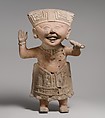
Smiling figure (Sonriente), South central Veracruz artist(s), Ceramic, slip, paint, Classic Veracruz
South central Veracruz artist(s)
600–1000 CE
Dish with Abraham and Melchizedek, Hans of Landshut  German, Free-blown glass with paint and metallic foils, South German
Hans of Landshut
1498
Aquamanile in the Form of Aristotle and Phyllis, Bronze; Quaternary copper alloy (approx. 72% copper, approx. 17% zinc,<br/>approx. 6% lead, approx. 3% tin)., South Netherlandish
South Netherlandish
late 14th or early 15th century
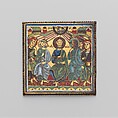
Plaque with the Pentecost, Champlevé and translucent enamel on copper gilt, South Netherlandish
South Netherlandish
ca. 1150–75
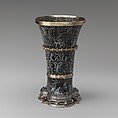
Beaker with Apes, Silver, silver gilt, and painted enamel, South Netherlandish
South Netherlandish
ca. 1425–50
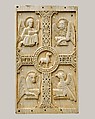
Plaque with Agnus Dei on a Cross between Emblems of the Four Evangelists, Elephant ivory, South Italian
South Italian
1000–1050
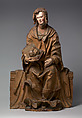
Saint Stephen, Hans Leinberger  German, Limewood with traces of paint, South German
Hans Leinberger
ca. 1525–30
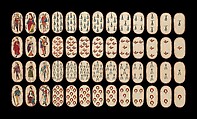
The Cloisters Playing Cards, Paper (four layers of pasteboard) with pen and ink, opaque paint, glazes, and applied silver and gold, South Netherlandish
South Netherlandish
ca. 1475–80
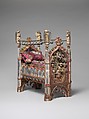
Crib of the Infant Jesus, Wood, polychromy, lead, silver-gilt, painted parchment, silk embroidery with seed pearls, gold thread, translucent enamels, South Netherlandish
South Netherlandish
15th century
Silver strigil (scraper), Silver, Possibly South Italian or Etruscan
Possibly South Italian or Etruscan
early 3rd century BCE
Beaker, Glass, Austrian, probably Vienna, or Bohemia
Austrian, probably Vienna, or Bohemia
20th century
Snaffle Bit, Iron alloy, European, Bohemia
European, Bohemia
1st–4th century
Lidded saltcellar, Temne or Bullom artist(s), Ivory, Temne or Bullom
Temne or Bullom artist(s)
ca. 1490–1530
The Temptation of Adam and Eve and The Crucifixion, Hans Reinhart the Elder  German, Silver, gilt, German, Saxony
Hans Reinhart the Elder
1536
The Temptation of Adam and Eve and The Crucifixion, Hans Reinhart the Elder  German, Silver, German, Saxony
Hans Reinhart the Elder
1536
Man, Fox and Maiden in a Landscape, Glass, German, Saxony
German, Saxony
ca. 1740