Music Lovers
According to a 1922 account, the painting derived from months of study of various individuals standing in line for performances at New York’s Metropolitan Opera House. Established as an alternative to the old-moneyed and discriminatory Academy of Music, the Opera House drew a more diverse cross-section of New Yorkers. The painting includes a portrait of the artist’s mother, Anne Bernstein, who faces forward in elegant black-and-white attire, holding an umbrella and program. Music Lovers was acclaimed on its debut in the National Academy annual as "stunning," with other critics noting that Bernstein was a young artist to watch.
Artwork Details
- Title: Music Lovers
- Artist: Theresa Bernstein (American, born Poland, Kraków 1890–2002 New York)
- Date: 1915
- Culture: American
- Medium: Oil on canvas
- Dimensions: 40 × 50 in. (101.6 × 127 cm)
- Credit Line: Marguerite and Frank A. Cosgrove Jr. Fund, 2023
- Object Number: 2023.734
- Curatorial Department: The American Wing
Audio
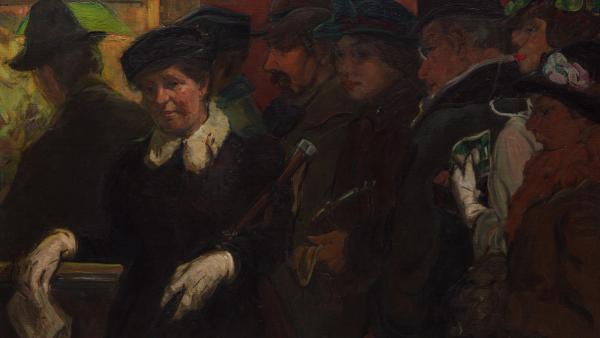
4041. Theresa Bernstein, Music Lovers, 1915
CAROLYN GUZSKI: We’re in the box office vestibule of the original Metropolitan Opera. The box office was rather small, and we see this variety of individuals, cheek-by-jowl.
NARRATOR: The crowd in this painting might initially appear as just a mass of people, all music lovers. But Carolyn Guzski, a professor of musicology at Buffalo State University, sees differences in their social classes and a story of immigration.
CAROLYN GUZSKI: The woman standing in front of the silk top-hatted man is clearly a member of the working class. She is clutching a handsome, but sturdy, pocketbook, which might be a way of showing that this is a sacrifice for her, but she's willing to make it.
The woman in back of the silk-hatted man is a different story altogether. Her hat is much more elaborate. She also seems to be holding opera glasses, which indicates that she's a regular.
NARRATOR: At the rear left, artist Theresa Bernstein highlights another New York immigrant.
CAROLYN GUZSKI: The man at the ticket window, is wearing a conical soft hat, very typical of the Italian working class.
At that time there was a group of old school Italian artisans that gathered in the uppermost balcony standing room. They were shoemakers, bricklayers, butchers, bakers, and they came to the opera frequently. And this man seems to be representative of that group.
NARRATOR: Although he may be buying a ticket far from the stage, he isn't at the back of the line; he’s first.
CAROLYN GUZSKI: Even the silk hatted gentleman behind him has to wait until this ticket purchase is completed. There is no secondary line for people of humbler means that are spending less money on tickets.
More Artwork
Press the down key to skip to the last item.
Research Resources
The Met provides unparalleled resources for research and welcomes an international community of students and scholars. The Met's Open Access API is where creators and researchers can connect to the The Met collection. Open Access data and public domain images are available for unrestricted commercial and noncommercial use without permission or fee.
To request images under copyright and other restrictions, please use this Image Request form.
Feedback
We continue to research and examine historical and cultural context for objects in The Met collection. If you have comments or questions about this object record, please contact us using the form below. The Museum looks forward to receiving your comments.