Marble vase with high foot and lug handles
This white marble collared jar is nearly intact with some loss at the upper neck and mended losses at the rim. It has a tall conical neck that slightly tapers upward and a wide mouth with a thick rounded rim that projects outward. Two horizontal bands delineate the rim from the rest of the neck. The body has somewhat flattened shoulders and a hemispherical to conical shape. It sits atop a high conical foot with a thick, rounded edge, the top of which is delineated by a shallow groove. The underside of the foot is carved concave. The four long, vertical, crescent-shaped lugs, carved crosswise at equidistance, are pierced at the same level for an even suspension. This type of vessel is often dubbed “kandila” as it resembles oil lamps of this name used in the Greek Orthodox Church.
A freely rendered, incised decoration resembling waves covers the exterior surfaces. Parallel oblique incisions decorate the neck and foot, and more vertical curvilinear incisions embellish the body. On account that they are freely executed, some lines are shorter and straighter near the lugs. Traces of uneven circular striations are noticeable in the interior. The large size of this vessel fits within the range of its type. It has been described as an early mature work of Kandila Sculptor A and possibly from Naxos.(1) However, it is the only known marble example of this type with such an incised decoration. Its closest parallel in size is a kandila in the Canellopoulos Museum in Athens.(2) Within the Stern Collection of Cycladic Art, L.2022.38.36, .72 and .110 are of similar size.
A large opaque fill (14 cm in length) at the rim and several smaller fills are visible in transmitted and ultraviolet light. The surface is partially covered with a roughly textured, pale-brown accretions. A ring of dark grey accretions is visible on the interior of the neck. There are scattered old and more recent-looking abrasions on the surface.
Georgios Gavalas and Linda Borsch
(1) See Getz-Gentle, Pat. 1996. The Stone Vessels of the Cyclades in the Early Bronze Age. pp. 5-39, University Park: The Pennsylvania State University Press. (2) See A62 (Athens, Canellopoulos Museum, inv. no. 1158) in Getz-Gentle, Pat. 1996. The Stone Vessels of the Cyclades in the Early Bronze Age. p. 244, University Park: The Pennsylvania State University Press; See also Choremi Spetsieri, Alkistis and Angelos Zarkadas, eds. 2006. The Paul and Alexandra Canellopoulos Museum: Ancient Art. cat. no. 6, p. 24; and Rambach, Jörg. 2000. Kykladen I, Die Frühe Bronzenzeit Grab- und Siedlungsbefunde. Athens NAM 4760, Paros, Glypha Grave 22, Bonn: R. Habelt.
Artwork Details
- Title: Marble vase with high foot and lug handles
- Period: Early Cycladic I
- Date: ca. 3200–2700 BCE
- Culture: Cycladic
- Medium: Marble
- Dimensions: Height: 10 3/8 in. (26.4 cm)
Width: 8 3/16 in. (20.8 cm)
Depth: 9 3/16 in. (23.4 cm)
Diameter: 4 5/16 in. (11 cm)
Thickness: 1/4 in. (.7 cm) - Classification: Stone Sculpture
- Credit Line: Leonard N. Stern Collection, Loan from the Hellenic Republic, Ministry of Culture
- Object Number: L.2022.38.132
- Curatorial Department: Greek and Roman Art
Audio
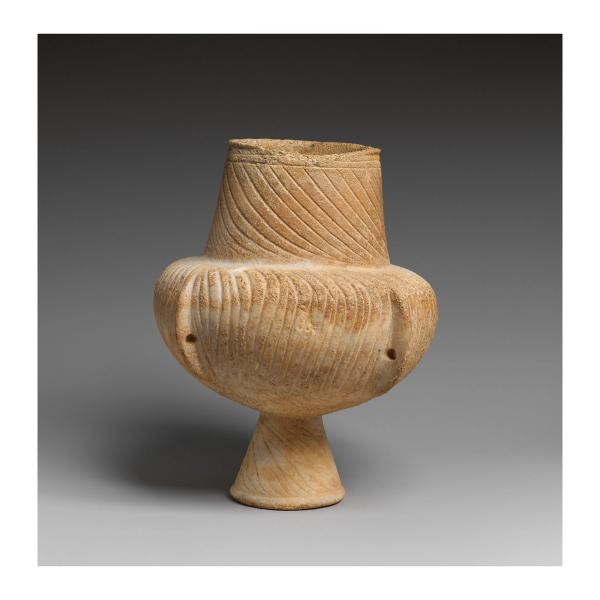
1332. Marble vase with high foot and lug handles (ca. 3200–2700 BCE)
Gavalas: Believe me, this is one of the most incredible objects to be found within a grave. It is so exciting.It's amazing.
Narrator: That’s Archaeologist Giorgos Gavalas. When I spoke with him, his passion for Bronze Age Cycladic culture was contagious. He explains that most of what we know about the period - which existed around 5000 years ago - comes from the few intact objects that’ve been discovered at preserved burial sites. But he says this marble vase still holds some secrets…
Gavalas: We are quite puzzled. There are suggestions that it could be some food accompanying the dead or some special offering.
Narrator: Does the shape of it offer us any hints?
Gavalas: These kinds of vessels were first recognized by the workmen as resembling candles that they were hanging on monasteries and on chapels. And that's why they have this nickname, as “Candela,” but actually they have nothing to do with such a function.
Narrator: Apparently, one clue to their function is the four handles with holes in them. These would’ve had a strip of rope or leather for carrying the vessel or for securing a lid. You can also see some intriguing incisions and grooves decorating the surface.
Gavalas: They have this great effect. They're facing different directions. It's like a spiral. If you go around it, you have this motion that something is moving. And it looks like the sea waves. It’s fascinating.
Narrator: The marble used is very fine. Just extracting it would’ve been a huge task. And then to produce an object like this, it must’verequired a highly specialized craftsman, but using what would’ve been a primitive drill - or - how did they do it?
Gavalas: Not everybody can have the mastery, let's say, to use this moving drill as you see here. This is a kind of a masterpiece.