Marble female figure
The figure, carved from very fine-grained (maximum grain size < 0.5 mm), homeoblastic marble with banded structure, is intact except for a slight loss at the bottom of the right foot. Brown accretions covering the back are minimal on the front, perhaps because the surface was aggressively cleaned. Red pigment identified as hematite appears on the proper right side of the face and head. As the pigment extends over the accretions and pitting of the surface, it is likely of modern origin. Scattered glossy areas appear to be the result of a modern consolidant. There is a raised vertical darkened patch in the area of the mouth, and spots of what appear to be iron corrosion on the back of the head and proper right leg.
The figure is of the Louros type, which represents an intermediate stage between the broader categories of abstract and naturalistic features. A schematic head, offset from the neck by a sculpturally defined chin, and flat torso are combined with carefully modeled legs. Triangular projections at the level of the shoulders represent arms. Small round breasts are carved in relief on the chest. The pubic area is defined by an incised horizontal line across the lower abdomen and by the rounded contours of the upper thighs. The fully articulated legs are divided in the front and back by deep vertical grooves, but are carved separately only from the mid-calves down. The buttocks and back of the legs are flatly modeled.
Although the proportions are characteristic of the Louros variety, the figure is a larger than average example of the type. The best parallels for the basic form, possibly carved by the same sculptor, come from a grave at Louros on Naxos. The presence of breasts in relief is also unusual, but does occur on the largest known Louros figure, now in Dresden.(1)
Alexis Belis, Dorothy Abramitis, and Federico Carò
(1) Pat Getz-Gentle, Personal Styles in Early Cycladic Sculpture (The University of Wisconsin Press, 2001), p. 15, on figures found together in Grave 26 at Louros attributed to the Stephanos Sculptor. The figure in Dresden is 28.6cm high: Dresden, Skulpturen sammlung H4 43/446.
Artwork Details
- Title: Marble female figure
- Period: Early Cycladic I
- Date: ca. 3200–2700 BCE
- Culture: Cycladic
- Medium: Marble
- Dimensions: Height: 7 9/16 in. (19.2 cm)
Width: 2 1/8 in. (5.4 cm)
Depth: 7/8 in. (2.3 cm) - Classification: Stone Sculpture
- Credit Line: Leonard N. Stern Collection, Loan from the Hellenic Republic, Ministry of Culture
- Object Number: L.2022.38.50
- Curatorial Department: Greek and Roman Art
Audio
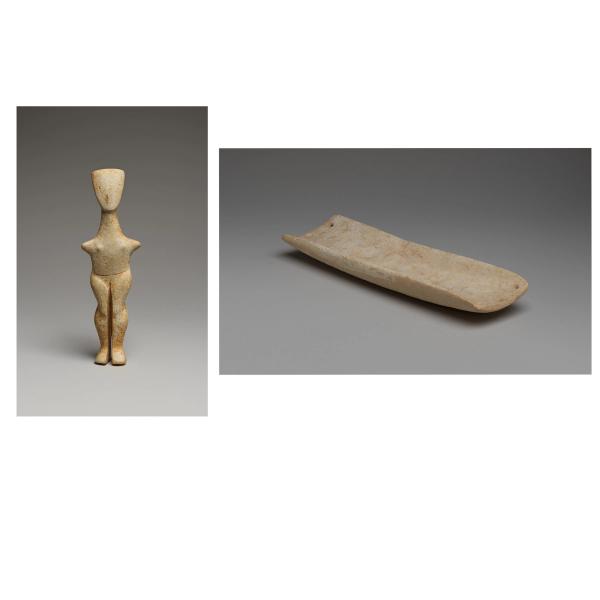
1333. Marble female figure & Marble palette (ca. 3200–2700 BCE)
Gavalas: There are many, many - interpretations about these early Cycladic figurines. They were identified as personal representations that had to do with the person who was buried within the grave. So it was a kind of way to protect himself from evil.
Narrator: Archaeologist Giorgos Gavalas explained to me that the early marble female figurine you’re looking is unusual. Not because of her triangular form head and curved hips, but because she’s made to stand independently. Do you also see the tray-like rectangular object that’s curved at the sides? It’s known as a “palette.”
Gavalas: Usually the top has some traces of pigments which were uh ground on the top of them. Archaeologists suggested that this would be identified as an artist's palette used for a painting, for body painting or tattoos.
Narrator: One fascinating detail you mentioned that’s related is that people may have been buried more than once, so after a few years, their skeleton would be reinterred and fit into a very small grave. Were they trying to conserve space? Or was it a ritual of some kind?
Gavalas: It was a great puzzle for many, many years. Then some finds indicated that there were multiple story graves.
Even today on the islands, the current burial habit is to have a primary burial within a grave, that after a period - which is either three, five or seven years - the bones should be removed. There needs to be a secondary burial ceremony, and of course in between these two processes there are many memorial services.
This treatment from the living to the dead is making a clear connection, it is this memory which is embodied, and it is so important for the formation of identity for these societies.