Marble female figure
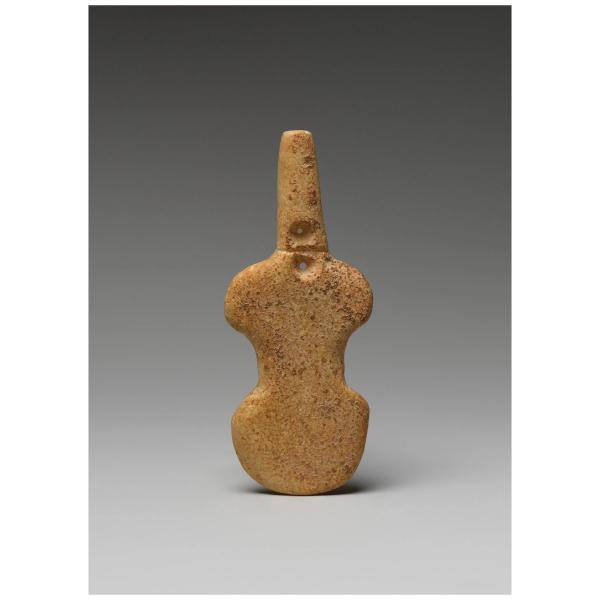
The figure, sculpted from white marble, is complete except for a break where the neck joins the body. The object is a rare example of Early Cycladic mending: an ancient repair, evident from two holes drilled from the front and the back of each piece with a semi-rotated borer, originally held the neck and body together. More recently, the break was bonded with a modern adhesive. One side of the figure is covered with a brown accretion, and white abraded areas on the surface of the marble are visible on the base and elsewhere. The figure is flat and takes the shape of a violin, created by the schematic outline of the female form with an elongated neck and broad shoulders and hips. The head is not articulated and there are no incised anatomical details on the front or back of the work.
The Violin type was the most common figural representation of the Early Cycladic I period. This piece is a characteristic example, with the shoulders slightly wider than the hips and one third of the total height devoted to the neck. The abstract hourglass shape suggests a seated position, derived from Late Neolithic female figures sitting with folded legs.
Alexis Belis and Wendy Walker
Artwork Details
- Title: Marble female figure
- Period: Early Cycladic I
- Date: ca. 3200–2700 BCE
- Culture: Cycladic
- Medium: Marble
- Dimensions: Height: 4 1/2 in. (11.5 cm)
Width: 1 3/4 in. (4.4 cm)
Depth: 7/16 in. (1.1 cm)
Thickness:1/2 in. (1.2 cm) - Classification: Stone Sculpture
- Credit Line: Leonard N. Stern Collection, Loan from the Hellenic Republic, Ministry of Culture
- Object Number: L.2022.38.39
- Curatorial Department: Greek and Roman Art
Audio
1331. Marble female figure (ca. 3200–2700 BCE)
NARRATOR: When some see this female figurine in marble – one of the earliest that’s on display in this gallery - the abstract form can prompt some questions: did early artists choose to keep the figure stylized and spare, or did they lack the skill to create a more detailed figure? In fact, no: I learned that in this same period, far more realistic female forms were being crafted out of clay. I asked archaeologist Giorgos Gavalas about whether they were always female.
GAVALAS: Within this period, we haven’t seen many male figures. There are a few in the Neolithic period of terracotta, with huge phallus indicating that this is definitely a male.
NARRATOR: I noticed the unusual shape of this figure; it’s a little bit like a musical instrument?
GAVALAS: We call it a violin or guitar shape. This specific object here doesn't have any details. The earlier Neolithic forms, they are much more naturalistic. We can't understand why they have decided to produce such an abstract form.
NARRATOR: We might look at the two holes on this figurine and wonder if it was used as a pendant, but its size suggests that this was not the case. In fact, the holes were drilled as part of an old repair - in the days before modern adhesives.
GAVALAS: The very interesting characteristic on this specific artifact is that it is broken, and people thought that it meant something really important, it symbolized something unique, and that's why they have taken the task to repair it, to do these two drillings, which are, believe me, a laborious effort without breaking the piece further, and mend it either by means of a rope or leather or even lead.
In the end, it was deposited in the burial.
NARRATOR: An object of personal significance like this was understood as a valuable thing to bring into the afterlife. Although these violin type figurines are usually interpreted as being seated, many of the Cycladic figures were designed to be displayed lying down, almost laid to rest.
GAVALAS: In general, we're talking about reclining figures in Cycladic art, because, of course, once you dig a grave, most of the time you can see them lying down, usually next to the head of the buried body.