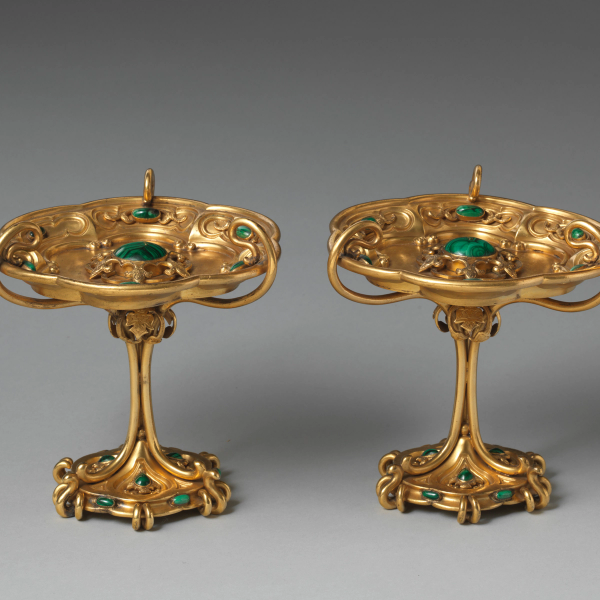
Small tazza (one of a pair, part of a set)
Artwork Details
- Title: Small tazza (one of a pair, part of a set)
- Maker: Asprey (British, founded 1781)
- Date: 1851
- Culture: British, London
- Medium: Gilt bronze, malachite
- Dimensions: Height: 5 in. (12.7 cm)
- Classification: Metalwork-Gilt Bronze
- Credit Line: Purchase, Gift of Irwin Untermyer, Loretta Hines Howard and Charles Hines, in memory of Mr. and Mrs. Edward Hines, and J. Pierpont Morgan, by exchange, 1982
- Object Number: 1982.88.8
- Curatorial Department: European Sculpture and Decorative Arts
Audio
417. The Great Exhibition
Gallery 516
NARRATOR: Maybe you’ve been to a Design or Tech Expo, to marvel at what’s new and cutting edge? This desk set, by the Asprey company, won awards at a Victorian equivalent: The Great Exhibition of 1851. It includes daily necessities: a calendar, candlesticks, pen tray and paper cutter—all rendered in gilt bronze and malachite. The show was held in a huge glass structure known as the Crystal Palace, in London.
CHARLOTTE BRONTE: Yesterday I went for the second time to the Crystal Palace . . .
NARRATOR: That’s Charlotte Brontë, the novelist, writing to friend.
CHARLOTTE BRONTE: It is a wonderful place – vast, strange, new and impossible to describe.
NARRATOR: The Great Exhibition was a grand fair, the ultimate tradeshow. The objects on display were chosen with a larger, political agenda: to trumpet not just the industrial supremacy of the British empire, but its overwhelming colonial power. Prince Albert, Queen Victoria’s husband, was the instigator.
CHARLOTTE BRONTE: Its grandeur does not consist in one thing, but in the unique assemblage of all things. Whatever human industry has created you find there, from the great compartments filled with railway engines and boilers, with mill machinery in full work, with splendid carriages of all kinds, with harness of every description, to the glass-covered and velvet-spread stands loaded with the most gorgeous work of the goldsmith and silversmith . . .”
NARRATOR: The exhibition prompted animated conversation about design, since it gave the British makers and the middle class alike a chance to respond to luxury, taste-making, pose questions—and even make decisions—about what comes next.
More Artwork
Press the down key to skip to the last item.
Research Resources
The Met provides unparalleled resources for research and welcomes an international community of students and scholars. The Met's Open Access API is where creators and researchers can connect to the The Met collection. Open Access data and public domain images are available for unrestricted commercial and noncommercial use without permission or fee.
To request images under copyright and other restrictions, please use this Image Request form.
Feedback
We continue to research and examine historical and cultural context for objects in The Met collection. If you have comments or questions about this object record, please contact us using the form below. The Museum looks forward to receiving your comments.