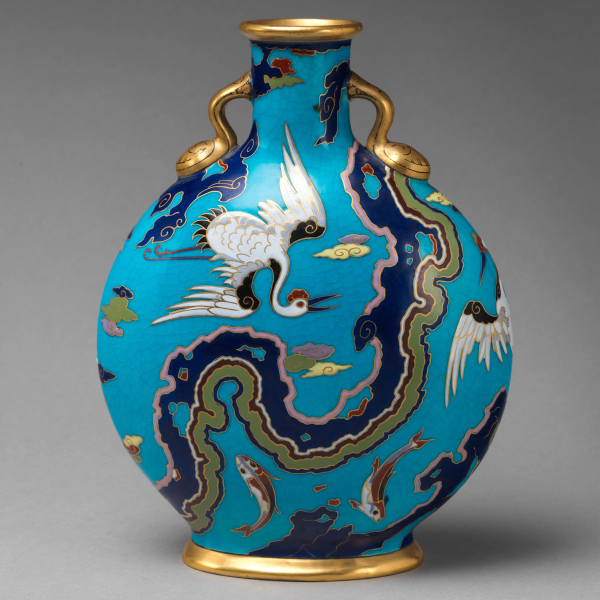
Moon flask with crane and fish motifs
Artwork Details
- Title: Moon flask with crane and fish motifs
- Designer: Design attributed to Christopher Dresser (British, Glasgow, Scotland 1834–1904 Mulhouse)
- Maker: Minton(s) (British, Stoke-on-Trent, 1793–present)
- Date: 1870
- Culture: British, Stoke-on-Trent, Staffordshire
- Medium: Bone china with enamel decoration and gilding
- Dimensions: confirmed: 7 3/4 × 6 × 3 1/8 in., 15.872oz. (19.7 × 15.2 × 7.9 cm, 450g)
- Classification: Ceramics-Porcelain
- Credit Line: Gift of Helene Fortunoff and Robert Grossman, 2017
- Object Number: 2018.62.3
- Curatorial Department: European Sculpture and Decorative Arts
Audio
418. Christopher Dresser and the Birth of Industrial Design
Gallery 516
NARRATOR: This riot of bottles, flasks, and vases–in glass, metal, and rainbow-colored ceramic¬–was created thanks in part to new technology that allowed for mass production. Suddenly, consumers had the freedom to choose among diverse colors and designs to suit their own, personal tastes. The abundance is also thanks to one man, possessing a unique combination of imagination and marketing savvy. Meet Christopher Dresser, one of the very first “industrial designers.”
Dresser’s approach to decorative arts was exuberant, as you can see. He embraced a range of historical styles from across the globe. In this case, are examples of his refined, simple aesthetic, inspired by the high-quality crafts he discovered on his travels to Japan. But in others, patterns and shapes reflect his appreciation for ornamentation, whether that of traditional Chinese, near Eastern, or Latin and South American art. And don’t forget his training as a botanist, inspiration you can spot in his use of forms found in nature—leaves, flowers, even the limbs of insects. Can you spot them here?
In the big picture, these objects reflect the impact of what’s known as "the design reform movement." This ideology favored the industrial revolution to produce consumer goods, not traditional artisans. What did this mean for the average person? A revolution not just in technology, but in choice. In the nineteenth century, the kind of shopping we do today was unimaginable: we have a massive range of access (Shop at a big box store? A small business? Online?) plus we get to choose from an enormous range of available price points. These options were born out of the work of Dresser and his peers: it was the first time that middle-class consumers were empowered to express their taste and personal style without breaking the bank.
A flamboyant figure of enormous influence, Dresser was very popular among his peers. Sadly, much of his output is lost to time, as all of his notes were lost in a fire in the 1950s.
More Artwork
Press the down key to skip to the last item.
Research Resources
The Met provides unparalleled resources for research and welcomes an international community of students and scholars. The Met's Open Access API is where creators and researchers can connect to the The Met collection. Open Access data and public domain images are available for unrestricted commercial and noncommercial use without permission or fee.
To request images under copyright and other restrictions, please use this Image Request form.
Feedback
We continue to research and examine historical and cultural context for objects in The Met collection. If you have comments or questions about this object record, please contact us using the form below. The Museum looks forward to receiving your comments.