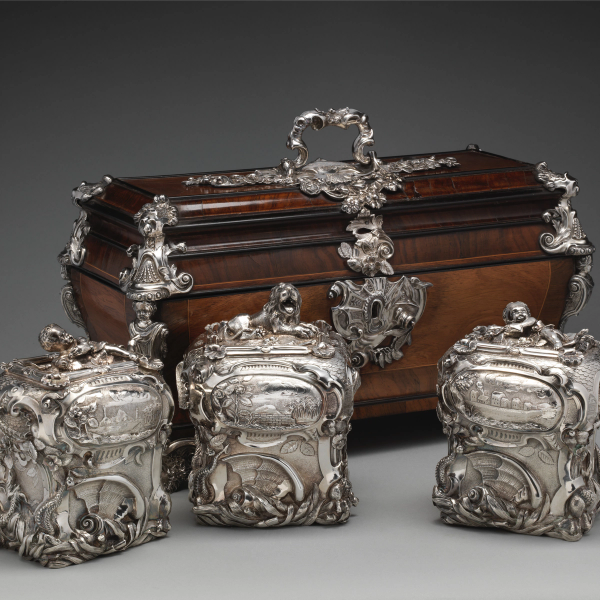
Pair of tea caddies and a sugar box in a case
A unique survival, the set bears the arms of the English Tory politician Sir James Dashwood, 2nd Bt (1715–1779) and his wife Elizabeth Spencer, and was likely commissioned to mark their nuptials in 1738. Indeed, the object’s level of sophistication hints at the fact that we must be looking at a special commission rather than a piece made for stock upon which subsequently could be engraved the arms of the acquirer.
Paul de Lamerie ranks amongst the most significant, prolific and inventive silversmiths of early Georgian England. He was born in the Low Countries in 1688, the son of Huguenot emigres, and moved to London with his family shortly after the installation of King William III. Appointed goldsmith to George I in 1716, Lamerie would advance to become one of the most successful suppliers of silver to the British aristocracy as well as foreign rulers, such as Catherine the Great of Russia and Joao V of Portugal.
Sir James Dashwood, for whom the present tea caddies were made, inherited a vast fortune from his grandfather, Sir Robert Dashwood, 1st Bt in 1734. In 1738, he became High Sheriff of Oxfordshire and married Elizabeth Spencer. This alliance with one of the most distinguished families in England (which produced the dukes of Marlborough and later the earls Spencer) cemented Dashwood’s social standing. In 1742, Dashwood began the erection of Kirtlinton Park, of which the dining room was moved to the Metropolitan Museum in 1931 (32.53.1).
The caddies and the room are reflections of Dashwood’s significant wealth as well as of his extraordinary social and artistic ambitions. As domestic objects of the finest quality of which the form pushes the boundaries of Rococo imagination while illustrating the commodities gained through Empire, the caddies encapsulate the overarching theme of the Met’s new British Galleries, focusing on the resourcefulness of Britain’s entrepreneurial society and its international trade.
Artwork Details
- Title: Pair of tea caddies and a sugar box in a case
- Maker: Paul de Lamerie (British, 1688–1751, active 1712–51)
- Date: 1738/39
- Culture: British, London
- Medium: Silver; oak, rosewood with boxwood and ebony inlay, silver mounts
- Dimensions: Case: h. 7 ½ in. w. 13 ¼ in. d. 5 ½ in.
Sugar box: h. 6 in. w. 4 ½ in.
Pair of caddies: h. 5 ¼ in. w. 4 ½ in. - Classification: Metalwork-Silver
- Credit Line: Wrightsman Fund, 2022
- Object Number: 2022.254a–g
- Curatorial Department: European Sculpture and Decorative Arts
Audio
406. Trade and Empire
Gallery 510
NARRATOR: What do tea and sugar have to do with global, colonial expansion?
Think: Palm trees. Mosquitos. Tropical Heat. Not familiar conditions for the average British citizen. Starting in the 1600s–and then for centuries to come–the hunger for wealth and power drove Britain into the ruthless enterprise of empire-building.
In the corner case to the left of this text panel, you’ll find a silver tea caddy. On each side is what appears to be a nostalgic scene set in the Caribbean. At the time, consumers might have delighted in these images of novelties such as palm trees and thatched huts, while barely considering that the tea inside was harvested by enslaved men and women.
There were voices (initially a minority) criticizing slave labor, and some objects here indicate how the retail market found its way into their homes, too. Look for a small medallion, no larger than a quarter. It presents an enslaved man on his knees, pleading with the words: “AM I NOT A MAN AND A BROTHER.” This voice of conscience slowly increased in volume, until societal values began to shift.
NARRATOR: Take John Newton, once the operator of a British slave ship. He described the inhuman conditions in which he transported the captured:
JOHN NEWTON: The slaves lie in two rows, one above the other, on each side of the ship, like books upon a shelf.
NARRATOR: Newton later repented, eventually authoring the hymn, Amazing Grace. These objects, and their complicated stories remain. Consider Olaudah Equiano, who was sold into slavery in West Africa as a child and taken to work the fields in the West Indies of the Caribbean Sea. His seminal book, The Middle Passage, describes the horrific voyage:
OLAUDAH EQUIANO: The closeness of the place, and the heat of the climate, added to the number in the ship, which was so crowded that each had scarcely room to turn himself, almost suffocated us. . . The shrieks of the women, and the groans of the dying, rendered the whole a scene of horror almost inconceivable . . . I now saw myself deprived of all chance of returning to my native country . . . I now wished for the last friend, Death, to relieve me.
More Artwork
Press the down key to skip to the last item.
Related Content
Publications
Books, guides, and catalogues published by The Met.
 Free to download
Research Resources
The Met provides unparalleled resources for research and welcomes an international community of students and scholars. The Met's Open Access API is where creators and researchers can connect to the The Met collection. Open Access data and public domain images are available for unrestricted commercial and noncommercial use without permission or fee.
To request images under copyright and other restrictions, please use this Image Request form.
Feedback
We continue to research and examine historical and cultural context for objects in The Met collection. If you have comments or questions about this object record, please contact us using the form below. The Museum looks forward to receiving your comments.