John Churchill, 1st Duke of Marlborough (1650–1722)
Artwork Details
- Title: John Churchill, 1st Duke of Marlborough (1650–1722)
- Artist: John Michael Rysbrack (Flemish, Antwerp 1694–1770 London)
- Date: early to mid-1730s
- Culture: British
- Medium: Carrara marble
- Dimensions: Overall (assembled, wt. confirmed): 36 5/8 in., 245 lb. (93 cm, 111.1 kg);
Overall (bust only, wt. confirmed): 24 13/16 in., 155 lb. (63 cm, 70.3 kg);
Overall (socle only, wt. confirmed): 90 lb. (40.8 kg) - Classification: Sculpture
- Credit Line: Purchase, Director's Fund, Wrightsman Fund, in honor of Olga Raggio, and Mr. and Mrs. J. Tomilson Hill, Hester Diamond, and Mr. and Mrs. Richard L. Chilton Jr. Gifts, 2015
- Object Number: 2015.35
- Curatorial Department: European Sculpture and Decorative Arts
Audio
409. The Age of Enlightenment
Gallery 512
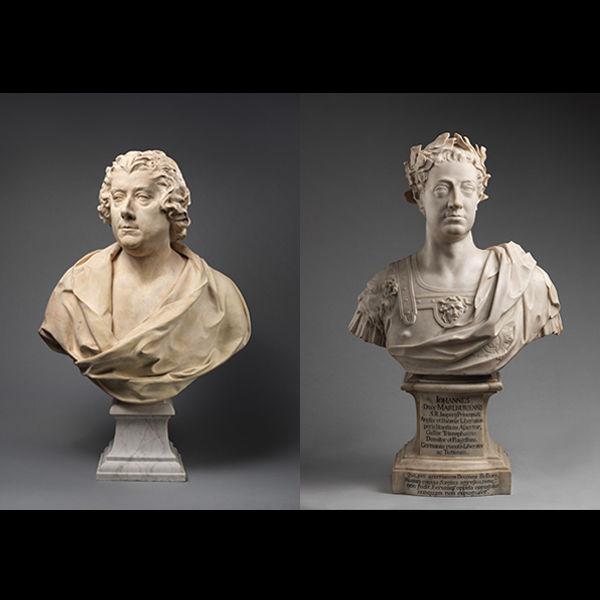
NARRATOR: Flanking the entrance to the gallery you will find sculptures from two émigré craftsmen—among the many great painters, architects, and artisans from the European continent who made their way to London. On the left, you see a masterful depiction of the Duke of Marlborough, famed for fighting the troops of Louis XIV. Here he’s dressed like a hero of the Roman empire, sculpted by the Flemish artist John Michael Rysbrack. On the right, a rendering of the Italian opera singer Francesco Bernardi, or 'il Sinesino,' by French-born Louis-Francois Roubiliac, a member of the thriving community of French Huguenot craftspeople in London. They were talented emigres who contributed to the metropolis's international spirit.
Above the busts are a pair of painted portraits. Their technique and pastoral subjects exemplify a uniquely British style, by native British painters, George Romney and Sir Joshua Reynolds. Both were celebrated members of King George III's newly-established Royal Academy, founded during an era of progressive scholarship and philosophy known as "The Enlightenment."
VOLTAIRE: How I love the English boldness! How I love those who say what they think!
NARRATOR: These are the words of the philosopher Voltaire, a leading Enlightenment figure. In his view, England was “the land of liberty.” Persecuted in France for mocking the royal family, he was exiled to London. There, he was amazed that citizens were free of political reprisals and by the economic success of such a small nation.
VOLTAIRE: Posterity will very probably be surprised to hear that an island whose only produce is a little lead, tin, fuller’s earth, and coarse wool, should become so powerful.
NARRATOR: As the philosopher observed, London blossomed into a liberal-minded cosmopolitan center of commerce and discourse where art and design were at the center. If you wanted to catch up on the hot topics of the day with friends and strangers alike, you would simply head to London’s trendiest new hot spot: the coffee house, an entirely new phenomenon at the time. Much like cafes today, they were magnets for customers to sit and chat. They could even find a newspaper, a new product that gave England an unprecedentedly well-informed public.
More Artwork
Press the down key to skip to the last item.
Related Content
Publications
Books, guides, and catalogues published by The Met.
 Free to download
Research Resources
The Met provides unparalleled resources for research and welcomes an international community of students and scholars. The Met's Open Access API is where creators and researchers can connect to the The Met collection. Open Access data and public domain images are available for unrestricted commercial and noncommercial use without permission or fee.
To request images under copyright and other restrictions, please use this Image Request form.
Feedback
We continue to research and examine historical and cultural context for objects in The Met collection. If you have comments or questions about this object record, please contact us using the form below. The Museum looks forward to receiving your comments.