Magical Stela with Horus the Child
On the stela Isis speaks and recounts that while she and Horus were still hiding in the marshes, the child became ill. In her despair, she cried for help to the "Boat of Eternity" (the sun boat in which the god travels over the sky), "and the sun disk stopped opposite her and did not move from his place." Thoth was sent from the sun boat to help Isis and cured Horus by reciting a catalogue of spells. The spells always ended with the phrase "and the protection of the afflicted as well," indicating that by using these spells, any type of affliction in human beings would be healed.
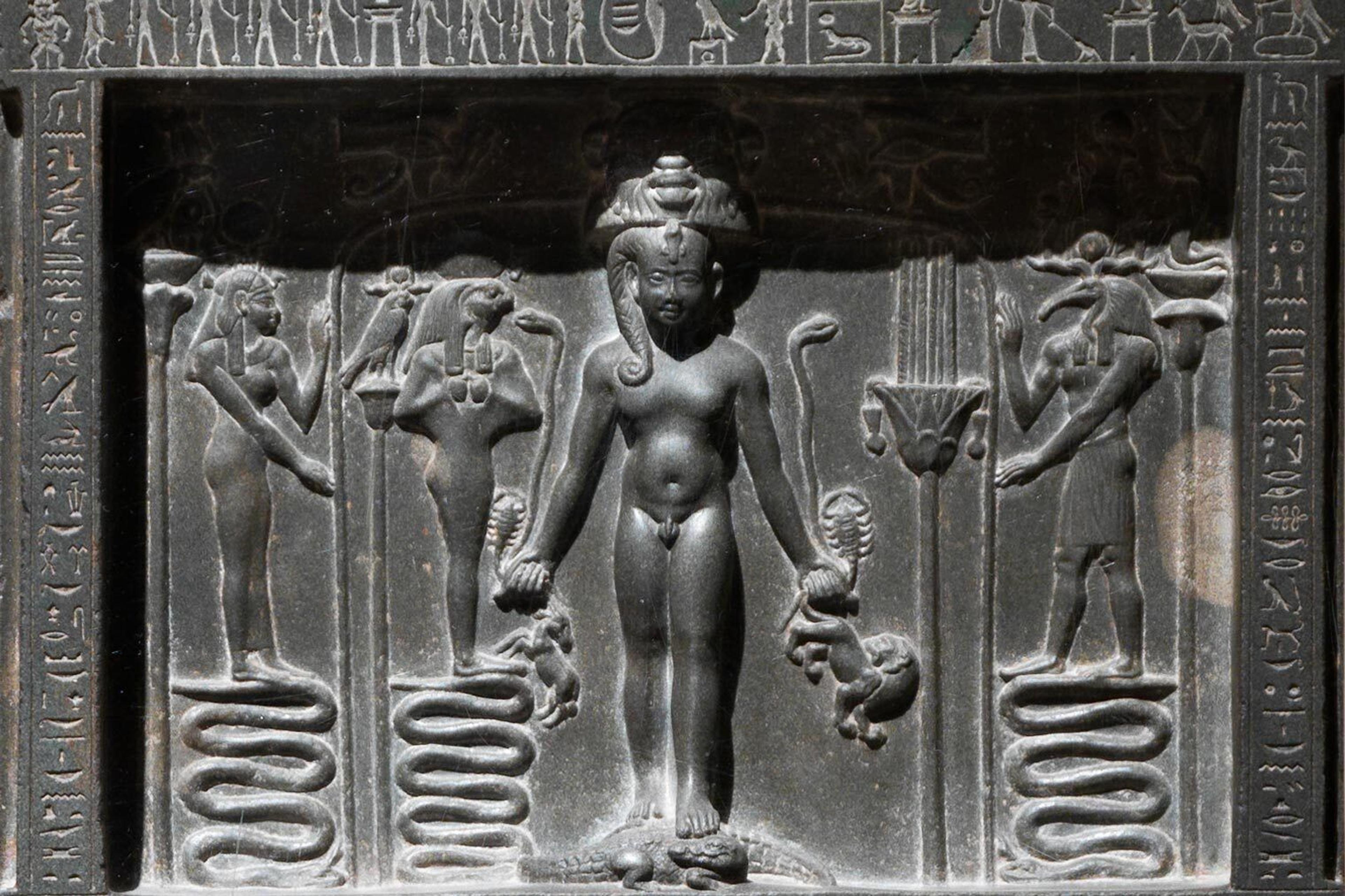
In this detail of the stela, Horus emerges from the background in such high relief that he is posed as an actual three-dimensional statue, with his left leg striding forward and his head directly facing the viewer. He is portrayed in the conventional Egyptian form for youth; that is, he is nude and wearing his hair in a sidelock. The soft, rounded forms of the bodies of Horus and the other deities are typical of the style of the period.
To symbolize his magic powers, Horus holds snakes and scorpions as well as an antelope (by its horns) and a lion (by its tail) in his closed fists. His feet rest on two crocodiles. Above him is the head of Bes, the dwarf deity with leonine features who had traditionally protected households but by this time had become a more general protective deity. Horus is flanked by three deities who stand upon coiled snakes. On the right is Thoth, identified by his ibis head, and on the left is Isis. Both protectively hold the walls of a curved reed hut, a primeval chapel, in which the Horus child stands together with a figure of Re-harakhty, god of the rising sun, and two standards in the form of papyrus and lotus columns. The lotus standard supports the two feathers of Osiris's headdress.
The images incised into the stone at the top of the stela portray the perilous nighttime journey of the sun as it passes through the nether world under the earth. Its rebirth each morning is shown at the uppermost point of the stela, where Thoth, four baboons, and the kneeling King Nectanebo II lift their arms in the gesture of adoration and prayer. Nectanebo II was the last indigenous king of ancient Egypt. He struggled valiantly against the Persian empire only to be defeated in the end. After the lost battle, he fled to Upper Egypt, and nothing is known about his end.
Artwork Details
- Title: Magical Stela with Horus the Child
- Period: Late Period
- Dynasty: Dynasty 30
- Reign: reign of Nectanebo II
- Date: 360–343 BCE
- Geography: From Egypt, Alexandria Region, Alexandria; Probably originally from Memphite Region, Heliopolis (Iunu; On), Temple of the Mnevis bulls
- Medium: Metagraywacke
- Dimensions: H. 83.5 × W. 33.5 × D. 14.4 cm, 52.6 kg (32 7/8 × 13 3/16 × 5 11/16 in., 116 lb.)
- Credit Line: Fletcher Fund, 1950
- Object Number: 50.85
- Curatorial Department: Egyptian Art
Audio
1159. Kids: Magical Stela, Part 1
Magic and religion were part of medicine in ancient Egypt, and this carved stone, called a “stela,” was believed to hold healing powers. The stone once stood in the public part of a temple. If you had been bitten by a poisonous snake or a scorpion, you could come to the stone to be healed.
Carved onto the stone are various texts ands images, including thirteen magical spells, for example, a “spell against poison.” The magical power of all these texts and images was activated when the texts were read out loud. But there was another way to be healed. Water could be poured over the stela and it would run over the images and words and magically absorb their healing powers. The victim could then drink this water that could cure him from the inside.
Now, look for the figure standing in the very middle of the stone, looking out at you. We can tell he’s a young boy from the long curl of hair on the side. But this can’t be just any boy. He’s holding snakes and scorpions in his hands even a small lion! And look under his feet. He’s standing on two deadly crocodiles.
This is the Egyptian god Horus when he was a little boy. To the right of Horus is a god with long curving bird beak. This is Thoth, the god of wisdom and writing, who also holds healing power! To the left of Horus are two more gods, on the very left is his mother, the goddess Isis. Horus was once cured of a poisonous bite. His story is written on the bottom part of this stone.
Do you want to hear the story? Just press PLAY, now.
Listen to more about this artwork
More Artwork
Press the down key to skip to the last item.
Related Content
Perspectives
Articles, audio, and video from The Met's online magazine.
Timeline of Art History
Entries and chronologies from The Met's art encyclopedia.

Publications
Books, guides, and catalogues published by The Met.
Research Resources
The Met provides unparalleled resources for research and welcomes an international community of students and scholars. The Met's Open Access API is where creators and researchers can connect to the The Met collection. Open Access data and public domain images are available for unrestricted commercial and noncommercial use without permission or fee.
To request images under copyright and other restrictions, please use this Image Request form.
Feedback
We continue to research and examine historical and cultural context for objects in The Met collection. If you have comments or questions about this object record, please contact us using the form below. The Museum looks forward to receiving your comments.