Chandelier
Artwork Details
- Title: Chandelier
- Artist: Thomas Hope (British (born Holland), Amsterdam 1769–1831 London)
- Date: ca. 1802
- Medium: Carved and gilded wood, with gilded metals (iron and brass or bronze).
- Dimensions: H. from bottom of pendants to top of stars: 120.6 cm; W. (overall): 108 cm.
- Classification: Metalwork
- Credit Line: Robert Lehman Collection, 1975
- Object Number: 1975.1.2494
- Curatorial Department: The Robert Lehman Collection
Audio
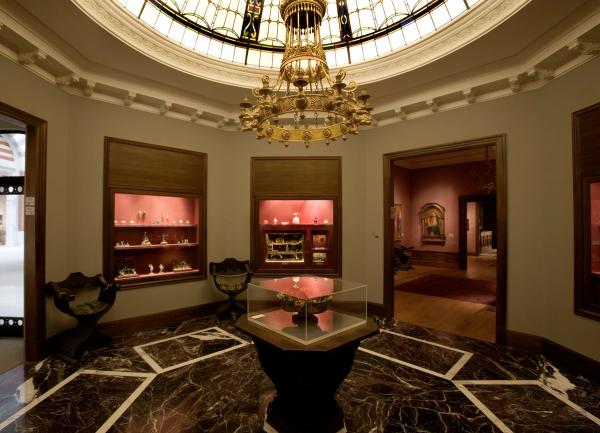
4705. Gallery Overview: Lehman Decorative Arts
Gallery 951
KANTER: Robert Lehman collected not just well-known objects, or objects by name artists, but also smaller, more precious objects that caught his fancy or that triggered an aesthetic response. He bought Renaissance jewelry, as many New York Collectors did. He bought European ceramics, porcelains, goldsmith's work. There's a very beautiful and important pocket watch in the collection. Only one, but it happens to be an enormously important one, belonging to Louis XIV, king of France. And we've chosen to display them here in this sort of wonder cabinet of small, precious objects.
AMORY: Take a moment to find the case that contains a number of pendants and other pieces of jewelry.
KANTER: What makes it so very interesting is that most of it is not Renaissance, but 19th Century. There was a great trade in fabricating Renaissance jewels in the 19th Century, which is to say all the jewels and the gold are real, but the craftsmanship is four centuries too late. We suspect that more than half of them are modern. But amongst the modern pieces are at least three that are of equal importance to Renaissance objects. They're by the greatest forger of the 19th Century. And we have them, carefully labeled and prominently displayed as the work of Reinhold Vasters. They're some of the objects of which we're proudest to be the owners.
More Artwork
Press the down key to skip to the last item.
Related Content
Publications
Books, guides, and catalogues published by The Met.
 Free to download
Research Resources
The Met provides unparalleled resources for research and welcomes an international community of students and scholars. The Met's Open Access API is where creators and researchers can connect to the The Met collection. Open Access data and public domain images are available for unrestricted commercial and noncommercial use without permission or fee.
To request images under copyright and other restrictions, please use this Image Request form.
Feedback
We continue to research and examine historical and cultural context for objects in The Met collection. If you have comments or questions about this object record, please contact us using the form below. The Museum looks forward to receiving your comments.