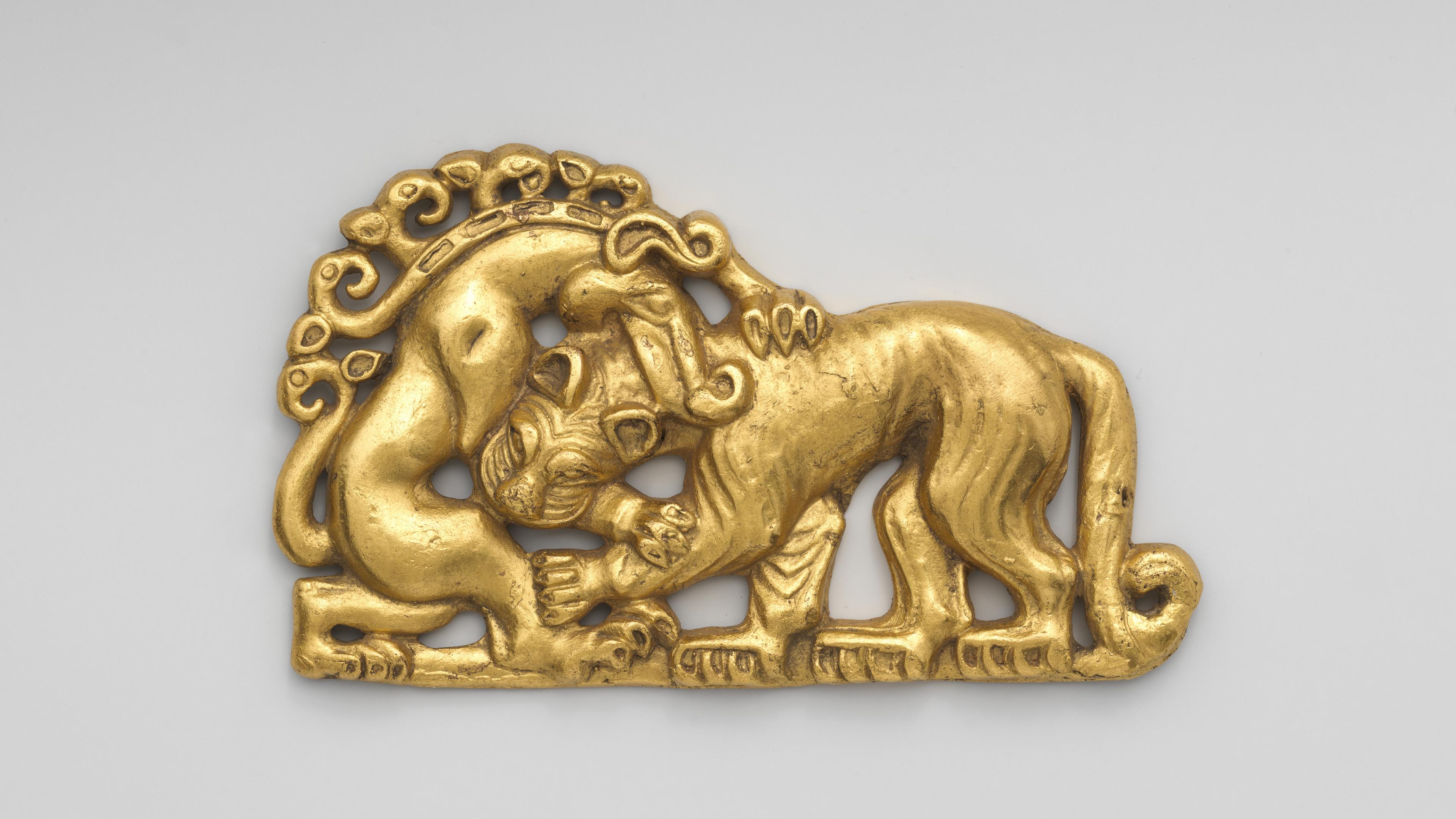
Sheet-gold decoration for a sword scabbard
The scabbard from which this gold decoration came would have been of another material, possibly bronze or iron. Such an elaborately embellished scabbard would have formed part of a ceremonial set of Scythian weapons typically including a sword, a bow, and a bow sheath. The Scythians were a nomadic people who lived in the Eurasian steppes during the first millennium B.C. Although the scabbard is of Scythian type, the decoration is Greek in style and undoubtedly of Greek workmanship. Similar sheet-metal goldwork from the royal cemetery at Vergina in northern Greece and from kurgans (burial mounds) of Scythian rulers in the North Pontic region (around the Black Sea) have been linked to the same workshop.
Artwork Details
- Title: Sheet-gold decoration for a sword scabbard
- Period: Late Classical or Hellenistic
- Date: ca. 340–320 BCE
- Culture: Greek or Scythian
- Medium: Gold
- Dimensions: length 21 7/16 in. (54.5 cm)
- Classification: Gold and Silver
- Credit Line: Rogers Fund, 1930
- Object Number: 30.11.12
- Curatorial Department: Greek and Roman Art
Audio
1060. Sheet-gold decoration for a sword scabbard
This object is an ornament for a sword scabbard. It is said to come from southern Russia, from the lands of the Scythians. The Scythians were a nomadic, horse-raising people who buried their chieftains with splendid golden objects. This piece may come from such a burial, but its decoration is in the spirit of Greek art. The Greeks established colonies along the Black Sea coast; Greek goldsmiths sometimes worked for Scythian patrons.
The decoration shows Greek warriors fighting with barbarians. Left of the center, a nude Greek has fallen; a comrade attempts to defend him from a barbarian spear. To the right, another Greek lunges forward. His opponent sinks to his knees. The kneeling barbarian fills the reduced height of the scabbard at this point. Further to the right, fallen horses and men fill even smaller spaces. In the triangular reserve at the top, the fierce energy of the battle scene finds its animal counterpart: a lion and a griffin attack two deer.
Greeks and non-Greeks are fighting here, but the artist has neither favored the Greeks nor belittled the barbarians. Both look equally noble, and we cannot tell which side will be victorious.
More Artwork
Press the down key to skip to the last item.
Related Content
Timeline of Art History
Entries and chronologies from The Met's art encyclopedia.
Publications
Books, guides, and catalogues published by The Met.
 Free to download
Research Resources
The Met provides unparalleled resources for research and welcomes an international community of students and scholars. The Met's Open Access API is where creators and researchers can connect to the The Met collection. Open Access data and public domain images are available for unrestricted commercial and noncommercial use without permission or fee.
To request images under copyright and other restrictions, please use this Image Request form.
Feedback
We continue to research and examine historical and cultural context for objects in The Met collection. If you have comments or questions about this object record, please contact us using the form below. The Museum looks forward to receiving your comments.