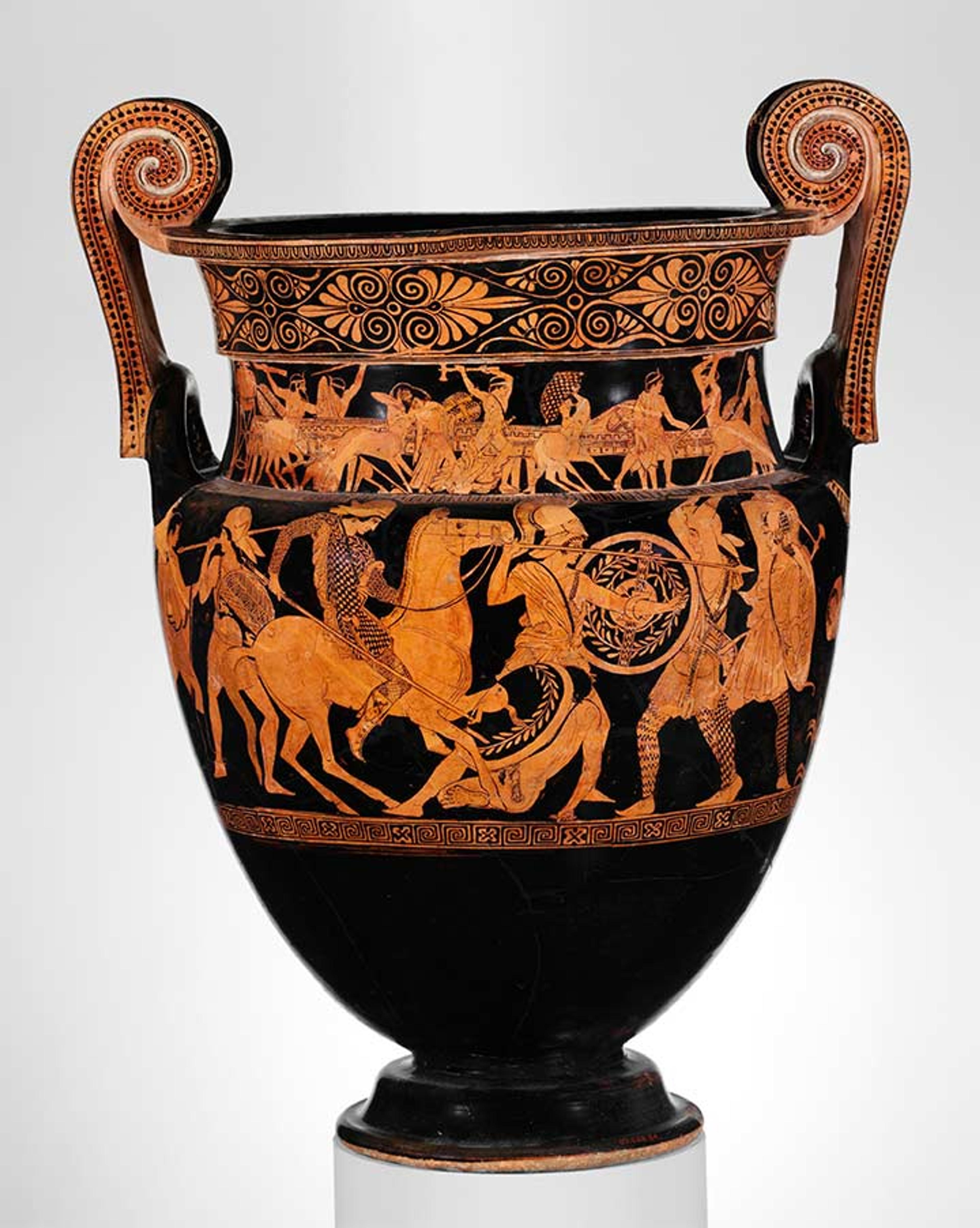
Terracotta volute-krater (bowl for mixing wine and water)
Around the body, Amazonomachy (battle between Greeks and Amazons)
The ancient Greeks almost never depicted contemporary or historical events in art. Thus, while literary works of the fifth century B.C. make clear that the Greeks understood the magnitude of their victory in the Persian Wars, there was no concern among artists to illustrate major events or personalities. Instead, their preference was for grand mythological battles between Greeks and eastern adversaries, notably Amazons. The Amazons were a mythical race of warrior women whose homeland lay far to the east and north. The most celebrated Amazonomachies in Athens during the first half of the fifth century were large-scale wall paintings that decorated the Theseion and the Stoa Poikile (the Painted Portico). Their influence was considerable and underlies the representation here and on the adjacent krater, 06.286.86.
Artwork Details
- Title: Terracotta volute-krater (bowl for mixing wine and water)
- Artist: Attributed to the Painter of the Woolly Satyrs (namepiece)
- Period: Classical
- Date: ca. 450 BCE
- Culture: Greek, Attic
- Medium: Terracotta; red-figure
- Dimensions: H. 25 in. (63.5 cm)
- Classification: Vases
- Credit Line: Rogers Fund, 1907
- Object Number: 07.286.84
- Curatorial Department: Greek and Roman Art
Audio
1036. Terracotta volute-krater (bowl for mixing wine and water)
The monumental form of this vessel is like an architectural support for the band of palmettes beneath the rim, and the two great battle friezes in the registers below. Two scenes from Greek mythology are depicted here.
In the smaller frieze on the neck of the vessel, men fight with centaurs. Sometimes the centaurs act as people should, and sometimes they are wild and rowdy animals. The bridegroom Peirithous invited them to his wedding, trusting them to behave. Instead, they got quite drunk and tried to carry off the bride and the other women present. The men are now at arms to set things straight. In the center of the scene, a nude Greek swings an axe above his head, while the centaur across from him holds up a checkered pillow.
The lower, larger scene shows the battle between the Greeks and the Amazons. The battle is fierce and the two sides evenly matched. An Amazon attacks a nude Greek on the ground with her spear. Walk around the vase to the right. Under the handle, a standing Greek forces an Amazon beyond the lower boundary of the scene.
Both battles were favorite themes in Greek art. In the fifth century B.C., Athens was exultant over the Greek victory in the Persian Wars. The Amazons were supposed to have come from the Near East; they may be metaphorical substitutes for the Persians, who were accused of effeminacy in Athenian rhetoric. The centaurs stand for chaos and barbarism pitted against the forces of civilization.
More Artwork
Press the down key to skip to the last item.
Related Content
Perspectives
Articles, audio, and video from The Met's online magazine.
Timeline of Art History
Entries and chronologies from The Met's art encyclopedia.
Publications
Books, guides, and catalogues published by The Met.
Research Resources
The Met provides unparalleled resources for research and welcomes an international community of students and scholars. The Met's Open Access API is where creators and researchers can connect to the The Met collection. Open Access data and public domain images are available for unrestricted commercial and noncommercial use without permission or fee.
To request images under copyright and other restrictions, please use this Image Request form.
Feedback
We continue to research and examine historical and cultural context for objects in The Met collection. If you have comments or questions about this object record, please contact us using the form below. The Museum looks forward to receiving your comments.