Tapestry Room from Croome Court
Artwork Details
- Title: Tapestry Room from Croome Court
- Designer: Room after a design by Robert Adam (British, Kirkcaldy, Scotland 1728–1792 London)
- Manufacturer: Tapestries and furniture covers manufactured by Manufacture Nationale des Gobelins (French, established 1662)
- Workshop director: Low-warp workshop of Jacques Neilson (French, 1714–1788)
- Designer: Tapestry general conception by Jacques Germain Soufflot (French, Irancy 1713–1780 Paris) of the Royal Gobelins Manufactory
- Designer: Tapestry medallions after designs by François Boucher (French, Paris 1703–1770 Paris)
- Maker: Furniture and curtain cornices made by William Ince (British, active ca. 1758/59–1794, died 1804)
- Maker: and John Mayhew (British, 1736–1811)
- Maker: for the firm Ince and Mayhew (British, London 1758/9–1811)
- Designer: Tapestry alentours and seat covers designed by Maurice Jacques (French, 1712–1784)
- Designer: and Louis Tessier (French, 1719/20–1781)
- Maker: Chair rails and paneling carved by Sefferin Alken (active 1744, died ca. 1783)
- Maker: Plaster ceiling and cornice moldings by Joseph Rose (1745–1799)
- Maker: Chimneypiece by John Wildsmith (active 1757–69)
- Maker: with frieze carved by Joseph Wilton (British, London 1722–1803 London)
- Maker: Grate basket and fender by Thomas Blockley
- Maker: Doors by John Hobcraft
- Maker: Marquery commode made by Peter Langlois (French, active 1759–81, worked in England 1760–70)
- Date: 1763–71
- Culture: British, Worcestershire with French, Paris (Gobelins) tapestry
- Medium: Plaster, pine, mahogany, bronze-gilt, marble, lapis lazuli, steel; wool and silk (22-24 warps per inch, 9-10 per centimeter)
- Dimensions: H. 27 ft. 1 in. (825.5 cm), W. 22 ft. 8 in. (690.9 cm), D. 13 ft. 10 3/4 in. (423.5 cm)
- Classifications: Textiles-Tapestries, Woodwork
- Credit Line: Gift of Samuel H. Kress Foundation, 1958
- Object Number: 58.75.1–.22
- Curatorial Department: European Sculpture and Decorative Arts
Audio
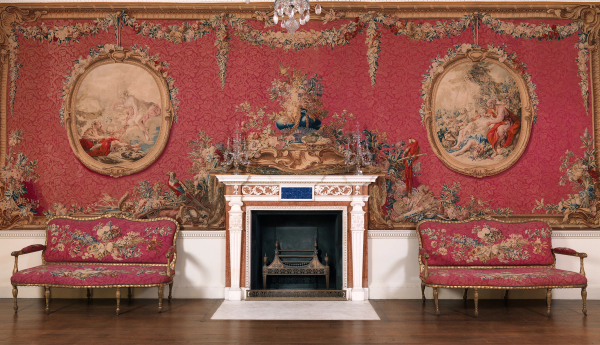
410. Tapestry Room from Croome Court
Gallery 514
NARRATOR: You’ve entered a room entirely brought (with its furnishings!) from Croome Court, the grand home of the Earl of Coventry. Coventry was a man of expensive, fashionable taste, as you’ll discover here. During the Seven Years War, which ended in 1763 and involved nations around the globe, Coventry was thwarted by a particular inconvenience: he couldn't travel to Paris, Europe's center of fashion. The Met's Wolf Burchard:
WOLF BURCHARD: As soon as the borders were reopened, Coventry rushed to the Gobelins tapestry manufactory, and commissioned this suite of tapestries that was partly designed by Francois Boucher, a great eighteenth-century painter whose paintings here are rendered in tapestry, in these very gutsy Rococo frames. They created this illusion that these pictures are hanging over a crimson, silk damask.
NARRATOR: Some of the most exciting details seem to be floating around the edges of the weavings.
WOLF BURCHARD: What you also have is all these trophies of fruits, and flowers, and lots, and lots of birds, beautifully rendered exotic birds. This is the height of tapestry making.
NARRATOR: This room was the pinnacle of luxury at Croome Court, designed by the most popular architect of the day, Robert Adam. Coventry wanted Adam for his reputation to deliver a cohesive harmony among all design elements, from the furniture to the wall and ceiling decorations.
WOLF BURCHARD: If you look along the walls, you have this wonderful suite of furniture that has tapestry covers that match the tapestries on the walls… They just had the covers shipped, and asked one of the best furniture makers, the firm of Mayhew and Ince, to produce the sofas and chairs, to match the covers.
NARRATOR: Coventry was a representative of the House of Commons and hosted his colleagues and members of the royal family here, including King George III, with whom he needed to reconcile. Coventry had resigned because of his opposition to Britain’s fighting what he considered the too-costly American Revolutionary war.
The wall hangings of this room were considered so elegant, that even the King could not
dine among them. Why? The odors of the food might cling to the textiles. Another guest took note of the incident:
RICHARD COOKSEY: Dinner was served in the salon… the king at first wished to dine in the tapestry room but altered his choice.
NARRATOR: One last thing about the ornamentation along the edges of the tapestries: Customers were able to request and pay by the number of details—each one coming at an additional cost.
WOLF BURCHARD: Not only could you supply the measures of your room, you could actually ask to have many more flowers, or many more birds.
More Artwork
Press the down key to skip to the last item.
Related Content
Timeline of Art History
Entries and chronologies from The Met's art encyclopedia.
Publications
Books, guides, and catalogues published by The Met.
Research Resources
The Met provides unparalleled resources for research and welcomes an international community of students and scholars. The Met's Open Access API is where creators and researchers can connect to the The Met collection. Open Access data and public domain images are available for unrestricted commercial and noncommercial use without permission or fee.
To request images under copyright and other restrictions, please use this Image Request form.
Feedback
We continue to research and examine historical and cultural context for objects in The Met collection. If you have comments or questions about this object record, please contact us using the form below. The Museum looks forward to receiving your comments.