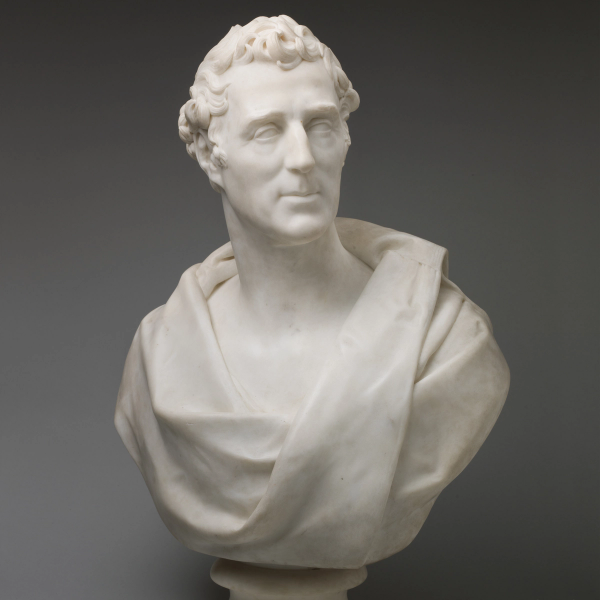
Arthur Wellesley, 1st Duke of Wellington (1769–1852)
Artwork Details
- Title: Arthur Wellesley, 1st Duke of Wellington (1769–1852)
- Artist: Sir Francis Chantrey (British, 1781–1841)
- Date: 1823
- Culture: British
- Medium: Marble
- Dimensions: wt. confirmed: 31 × 22 × 11 in., 160 lb. (78.7 × 55.9 × 27.9 cm, 72.6 kg)
Height, bust only: 25 3/4 in. (65.4 cm)
Height (column): 47 3/4 in. (121.3 cm) - Classification: Sculpture
- Credit Line: Wrightsman Fund, 1994
- Object Number: 1994.295a, b
- Curatorial Department: European Sculpture and Decorative Arts
Audio
415. The Regency Platform
Gallery 516
NARRATOR: Internationalism. Excess. Infamy.
WOLF BURCHARD: This platform is dedicated to the regency era, which is the very beginning of the 19th century in Britain.
NARRATOR: How do you sum up this period of palace intrigue and unapologetic glamour, flashy colors and contrasts? You can start by looking at this marble bust of the Duke of Wellington, depicted here in the style of a Roman hero. The Met's Wolf Burchard:
WOLF BURCHARD: The Duke of Wellington… was a key figure in the reorganization of Europe in the aftermath of the downfall of Napoleon… He is a man who stepped from the Age of Enlightenment into that of the Industrialization.
NARRATOR: Political turmoil in France flooded England with luxurious items from aristocratic homes, including the Palace of Versailles. Some were even stripped for parts—For example, the huge cabinet on this platform is made of wood panels inlaid with hardstones, (or "Pietra Dura" in Italian), that have been carefully cut into shapes.
WOLF BURCHARD: These fruits and flowers are salvaged from often older pieces of furniture and reintroduced into new pieces.
NARRATOR: Speaking of new: Napoleon had been at the forefront of excavating ancient Egypt, which launched a showy craze–Egyptomania–that gripped French design at the beginning of the 19th century. Notice the glittering, golden candelabra.
WOLF BURCHARD: On top of the cabinet, we have these very beautiful, large candelabra that are in that Egyptomania style. And then on the right you have this beautiful, beautiful bench, a so-called Egyptian bench designed by Thomas Hope.
When you look at it very closely, you have a remarkable contrast between the burnished surface of the gilded wood and the very deep coral wool fragment we found on this bench.
NARRATOR: The Met’s conservation team did scientific analysis of that small fragment of coral-colored wool. Their discoveries led to choosing the similar upholstery that you see today.
More Artwork
Press the down key to skip to the last item.
Related Content
Publications
Books, guides, and catalogues published by The Met.
 Free to download
Research Resources
The Met provides unparalleled resources for research and welcomes an international community of students and scholars. The Met's Open Access API is where creators and researchers can connect to the The Met collection. Open Access data and public domain images are available for unrestricted commercial and noncommercial use without permission or fee.
To request images under copyright and other restrictions, please use this Image Request form.
Feedback
We continue to research and examine historical and cultural context for objects in The Met collection. If you have comments or questions about this object record, please contact us using the form below. The Museum looks forward to receiving your comments.