Armchair
Artwork Details
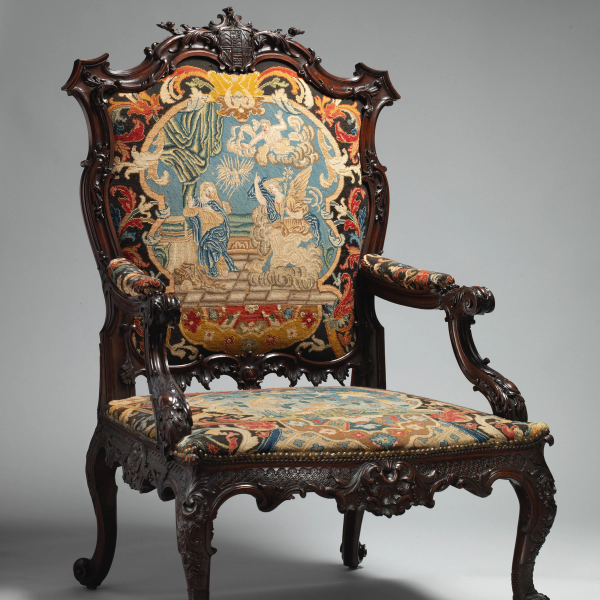
- Title: Armchair
- Designer: After a design by Thomas Chippendale (British, baptised Otley, West Yorkshire 1718–1779 London)
- Date: ca. 1755
- Culture: British
- Medium: Mahogany, needlework
- Dimensions: Overall: 51 × 31 1/2 × 33 in. (129.5 × 80 × 83.8 cm)
- Classification: Woodwork-Furniture
- Credit Line: Gift of Irwin Untermyer, 1964
- Object Number: 64.101.980
- Curatorial Department: European Sculpture and Decorative Arts
Audio
411. The Gentleman and Cabinet-Maker's Director
Gallery 512
NARRATOR: How does furniture from a catalogue… change the game? On the platform against the wall you’ll find the Barrington armchair, upholstered with delicate needlework. But there is more to its design than meets the eye.
WOLF BURCHARD: it's a chair that was made in the so-called French style because it's inspired by French Rococo furniture.
It’s very large, it's very gutsy, it's beautifully carved, it's made of mahogany. Mahogany became the national wood for English furniture in the 18th century, and it was a great status symbol. People would have known that it was very expensive, because it was sourced from the colonies, and then brought back to England.
NARRATOR: Before 1754, such a chair would’ve been created by an artisan using secretly guarded designs and techniques. Not this one. It was constructed from printed instructions—written and distributed by an enterprising designer: Thomas Chippendale.
WOLF BURCHARD: He produced his Gentleman and Cabinet Maker's Director, which was like a catalog in which you could choose your furniture. It had lots and lots of different styles, and you could then take that catalog to your cabinet maker, and have something made to your specifications.
THOMAS CHIPPENDALE: Upon the whole, I have given no design but what may be executed with advantage by the hands of a skillful workman… and I am confident I can convince all Noblemen, Gentlemen, or others, who will honor me with their commands, that every design in the book can be improved, both as to beauty and enrichment, in the execution of it.
NARRATOR: Today, we’re familiar with shopping catalogs, online retail, and a million other ways to conveniently get what we need. But arguably, this consumer-friendly model started with Chippendale.
Furniture design could now cater in new ways to a growing consumer market–and there are examples all around you in this gallery: along the walls and in the center case. Meanwhile, cultural upheaval mean that monarchs and aristocrats were not the only ones dictating what was desirable design–let alone “good taste.”
Chippendale’s influence has since crossed borders and time. It even inspired the designs of early American furniture. And his innovative approach–to make craftsmanship and design easily reproducible–is still seen in our homes today.
More Artwork
Press the down key to skip to the last item.
Related Content
Publications
Books, guides, and catalogues published by The Met.
 Free to download
Research Resources
The Met provides unparalleled resources for research and welcomes an international community of students and scholars. The Met's Open Access API is where creators and researchers can connect to the The Met collection. Open Access data and public domain images are available for unrestricted commercial and noncommercial use without permission or fee.
To request images under copyright and other restrictions, please use this Image Request form.
Feedback
We continue to research and examine historical and cultural context for objects in The Met collection. If you have comments or questions about this object record, please contact us using the form below. The Museum looks forward to receiving your comments.