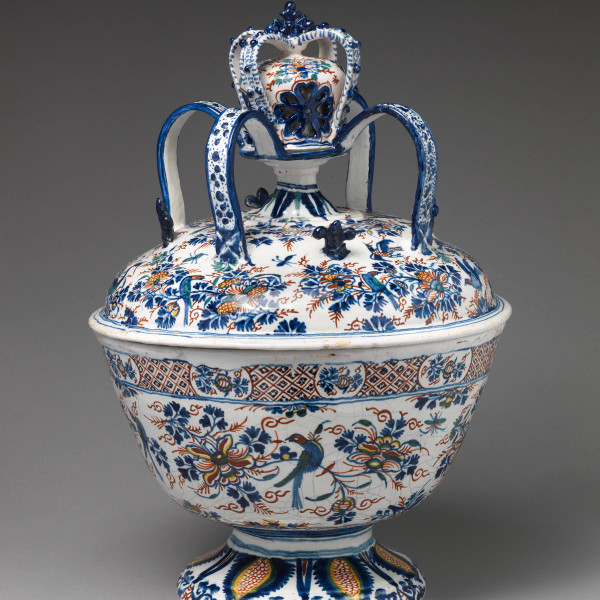
Ceremonial punch bowl with cover
Artwork Details
- Title: Ceremonial punch bowl with cover
- Date: ca. 1705
- Culture: probably British, Lambeth
- Medium: Delftware (tin-glazed earthenware)
- Dimensions: Height (overall): 17 11/16 in. (44.9 cm);
Overall (pot .25a): 8 5/8 × 11 7/8 in. (21.9 × 30.2 cm);
Overall (cover .25b): 7 1/4 × 12 1/4 in. (18.4 × 31.1 cm);
Height (finial .25c): 4 1/8 in. (10.5 cm) - Classification: Ceramics-Pottery
- Credit Line: Gift of Mr. and Mrs. Leslie R. Samuels, 1953
- Object Number: 53.25a–c
- Curatorial Department: European Sculpture and Decorative Arts
Audio
404. Ceramics and Craftsmanship
Gallery 509
NARRATOR: Today we might drink tea from a porcelain cup and think nothing of it. In the seventeenth century? It was a big deal. For example, the British considered this blue-and-white porcelain punchbowl an artistic marvel when it was imported from China. The material was completely unfamiliar, and coveted. As a maker of ceramics, Kate Malone understands the allure.
KATE MALONE: Porcelain is the finest grain, and it's the silkiest thing… if you think about porcelain and draw a parallel with the finest silk, and you think about brick clay, and you draw a parallel with sack cloth. it's the ultimate purity. It responds to every single touch. And it's the most difficult, and impatient, and demanding of materials, actually. I'm very scared of porcelain (laughs).
NARRATOR: The market for porcelain began with the monarch and his immediate circle. But with the opening of a new network of global trade, the appetite and market only grew.
In contrast, these cases also present brown earthenware “chargers,” or large plates produced by Thomas and Ralph Toft. Unlike porcelain, the brothers used a traditional, Northern European “slipware technique” to create the pots from moistened white clay. Their earthy, rustic style reflects both their material and process, which is very different from porcelain:
KATE MALONE: Everything to do with clay is about consistency. I try and wonder about the technology that Thomas had, himself, while he was making. I think he probably rolled a big slab, and then it was turned. There would have been the drawing, and then the filling in, with the beautiful, very thin, red-orangey slip. The way it's raised up, you know, the slip is much, much thicker than the painted areas of the orange slip. These days, we have a sort of rubber, sort of bulbous bulb, that you fill with liquid clay and you squeeze it and draw, as if it's like an icing bag… Thomas, he must have had maybe a, the bladder of a sheep or something (laughs). It's just joyous. And the freedom with which he did this drawing…
NARRATOR: This charger shows a very famous moment in the English Civil War, when the fugitive king Charles II evaded enemy forces by hiding in a tree. The Met's Wolf Burchard:
WOLF BURCHARD: The way it’s depicted here, it’s in a rather humorous manner... You have his head sticking out of the tree and you sort of think of him thinking, “Wow, that was a close one.”
More Artwork
Press the down key to skip to the last item.
Related Content
Publications
Books, guides, and catalogues published by The Met.
 Free to download
Research Resources
The Met provides unparalleled resources for research and welcomes an international community of students and scholars. The Met's Open Access API is where creators and researchers can connect to the The Met collection. Open Access data and public domain images are available for unrestricted commercial and noncommercial use without permission or fee.
To request images under copyright and other restrictions, please use this Image Request form.
Feedback
We continue to research and examine historical and cultural context for objects in The Met collection. If you have comments or questions about this object record, please contact us using the form below. The Museum looks forward to receiving your comments.