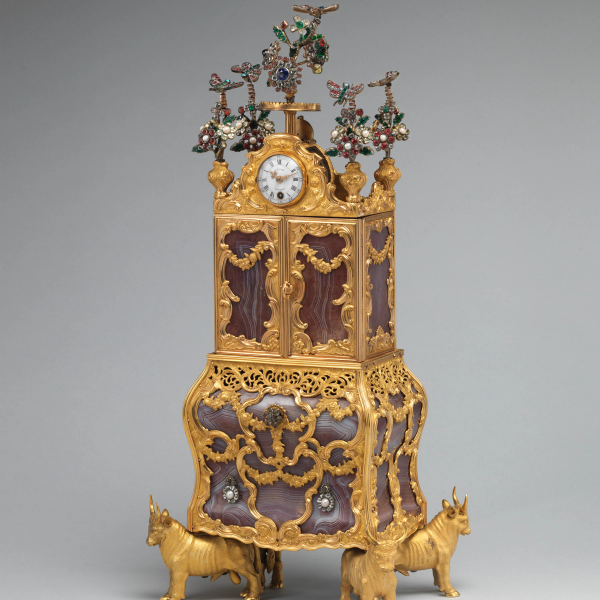
Miniature secretary incorporating a watch
Based on actual European Rococo cabinet designs, but with some improbable additions, the miniature is known to have been in the collection of Princess Z. M. Youssoupof in Saint Petersburg in 1904, and although it has been said to have been taken from China after the Boxer Rebellion in 1899, it may, in fact, have been imported into Russia long before.
Artwork Details
- Title: Miniature secretary incorporating a watch
- Entrepreneur: James Cox (British, ca. 1723–1800)
- Date: ca. 1766–72
- Culture: British, London
- Medium: Case: agate, with gold mounts, gilded brass, pearls, and paste jewels set in silver; Dial: white enamel; Movement: wheel balance and cock set with paste jewels
- Dimensions: Overall (confirmed): 12 1/8 × 5 3/4 × 4 1/8 in. (30.8 × 14.6 × 10.5 cm)
- Classification: Metalwork-Gold and Platinum
- Credit Line: Gift of Admiral F. R. Harris, in memory of his wife, Dena Sperry Harris, 1946
- Object Number: 46.184a–c
- Curatorial Department: European Sculpture and Decorative Arts
Audio
413. Retail Value: High and Low
Gallery 512
NARRATOR: You’re looking at a case chock full of gloriously excessive goodies. Take them in. Just imagine: You’ve never had the opportunity to see such a wealth of choices in your price range. It's eighteenth century London and throngs of people are joining in an exciting new pastime: shopping– the result of Britain’s exploding economy. As historian and novelist Tobias Smollett described shortly thereafter:
TOBIAS SMOLLETT: Commerce and manufacture flourished again, to such a degree of increase as had never been known to the island: but this advantage was attended with an irresistible tide of luxury and excess.
NARRATOR: As if overnight, a shiny sea of “toy shops” opened on London's main thoroughfares around St James’s, Bond Street, and Pall Mall. Rather than selling toys for children, these were for adults: wondrous, shiny, often purposeless objects made solely for amusement and delight.
This renaissance in retail laid the groundwork for how we shop today. It’s not what we need, but what we want, available at diverse “price points. Consider, here, the gold and silver clocks by the luxury manufacturer James Cox. Or how about one of these more affordable makeup cases, scent bottles, or model figurines? Do you prefer a playful design—a candy dish in the shape of a man’s head or a nest of bluebirds? Or obscene opulence, like a gold snuffbox decorated with scenes from antiquity? Admit it–you’re tempted.
More Artwork
Press the down key to skip to the last item.
Related Content
Timeline of Art History
Entries and chronologies from The Met's art encyclopedia.
Publications
Books, guides, and catalogues published by The Met.
 Free to download
Research Resources
The Met provides unparalleled resources for research and welcomes an international community of students and scholars. The Met's Open Access API is where creators and researchers can connect to the The Met collection. Open Access data and public domain images are available for unrestricted commercial and noncommercial use without permission or fee.
To request images under copyright and other restrictions, please use this Image Request form.
Feedback
We continue to research and examine historical and cultural context for objects in The Met collection. If you have comments or questions about this object record, please contact us using the form below. The Museum looks forward to receiving your comments.