Seasons and Elements (Spring) (set of four)
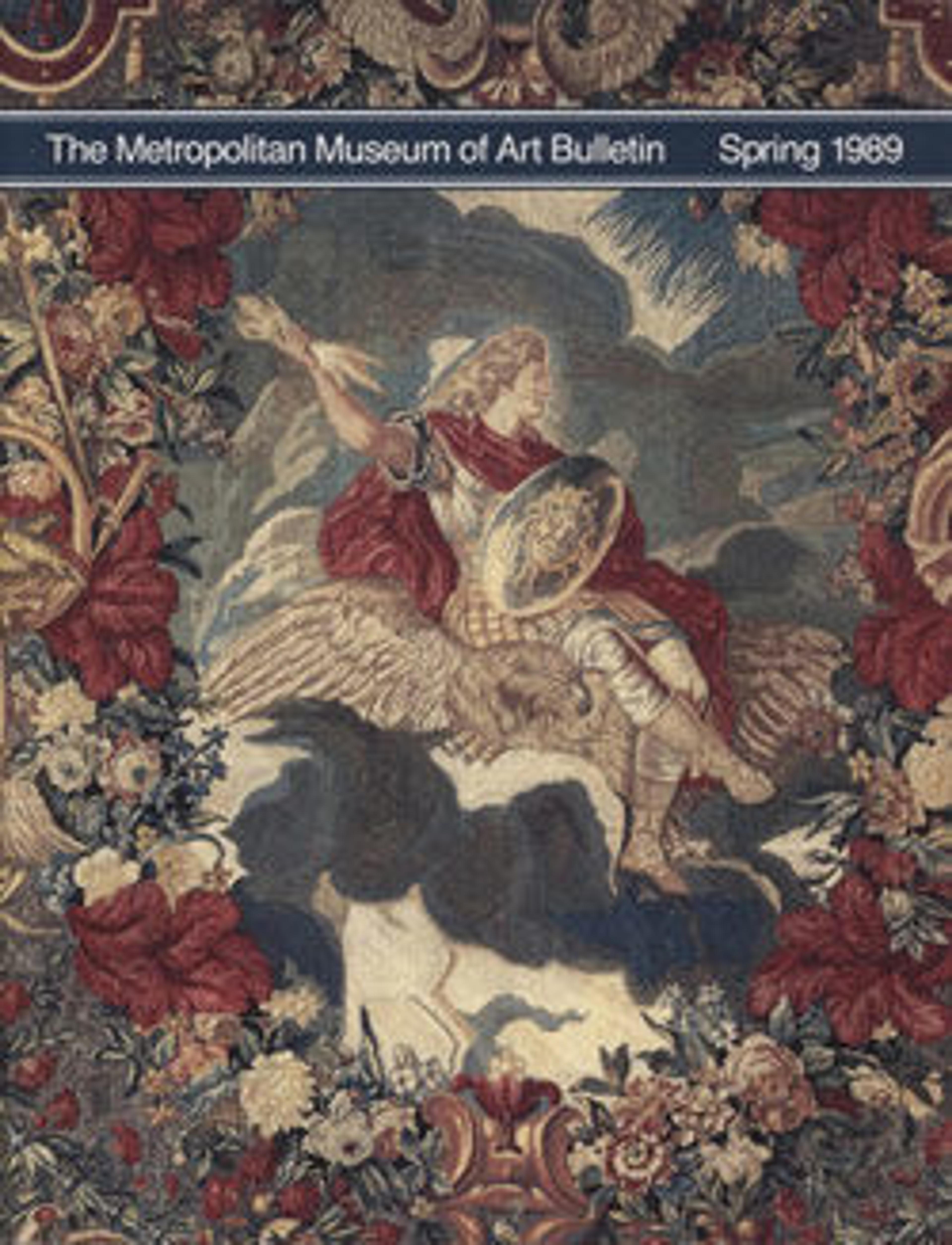
The central medallion in the panel that symbolizes air (MMA 46.43.4) features the king himself in the guise of Jupiter, holding a thunderbolt and a shield emblazoned with the head of the Gorgon Medusa and seated on a large eagle against a backdrop of billowing clouds. Various birds, insects, and wind instruments are rendered around this medallion, while a sunburst is shown above and Juno with peacock below. The closeness of the depiction of Louis XIV to an image of the king painted on the ceiling of the Hall of Mirrors at Versailles by Charles Le Brun in 1683 – 84 makes it likely that the designs for the main figures in the set of hangings were supplied by his workshop; however, they may be the work of the painter François Bonnemer (1638 – 1689 ), who is known to have made cartoons after compositions by Le Brun. In 1685 Bonnemer provided designs for the embroidered seat covers of the benches and stools in the Hall of Mirrors at Versailles. The alentours, or decorative borders, full of delightful details, are believed to be by Jean Lemoyen le Lorrain, an artist little known today who worked in the circle of Le Brun.
The other embroideries are thought to depict three of Montespan’s children with the king: Louise-Françoise, Mademoiselle de Nantes (1673 – 1743 ), with flowers symbolizing Flora, or spring (MMA 46.43.1); Françoise-Marie, Mademoiselle de Blois (1677 – 1749 ), with wheat ears, as Ceres, or summer (MMA 46.43.2); and Louis-Auguste, duc de Maine (1670 – 1736 ), in armor, as Mars, or fire (MMA 46.43.3).
The compositions of the seasons include floral wreaths with the zodiac symbols for the appropriate months, while salamanders, torches, smoking braziers, and censers pertain to the element fire. The background of these rare surviving embroideries is worked in metal thread, now tarnished, which must have given them a sumptuous and shimmering appearance when they were first made. The hangings were documented in 1718 as in the collection of Louis-Alexandre, comte de Toulouse (1678 – 1737 ), the youngest child of Louis XIV and Madame de Montespan, at the Château de Rambouillet. During the nineteenth century they belonged to King Louis-Philippe and were hung at the Palais Royal, Paris.
[Daniëlle Kisluk-Grosheide, adapted from The Wrightsman Galleries for French Decorative Arts/Daniëlle Kisluk-Grosheide and Jeffrey Munger; New York: Metropolitan Museum of Art; New Haven: Yale University Press, 2010]
Artwork Details
- Title: Seasons and Elements (Spring) (set of four)
- Designer: Possibly after a design by Charles Le Brun (French, Paris 1619–1690 Paris)
- Designer: Border probably designed by Jean Lemoyne le Lorrain (1637/38–1709)
- Patron: Commissioned for Marquise de Montespan (1641–1707)
- Date: ca. 1683
- Culture: French, Paris
- Medium: Canvas; silk, wool, and metal-thread embroidery in tent stitch (316 stitches per sq. inch, 49 per sq. cm.)
- Dimensions: L. 164 x W. 108 inches (416.6 x 274.3 cm)
- Classification: Textiles-Embroidered
- Credit Line: Rogers Fund, 1946
- Object Number: 46.43.1
- Curatorial Department: European Sculpture and Decorative Arts
Audio
2251. State Bedroom in the style of Louis XIV, Part 1
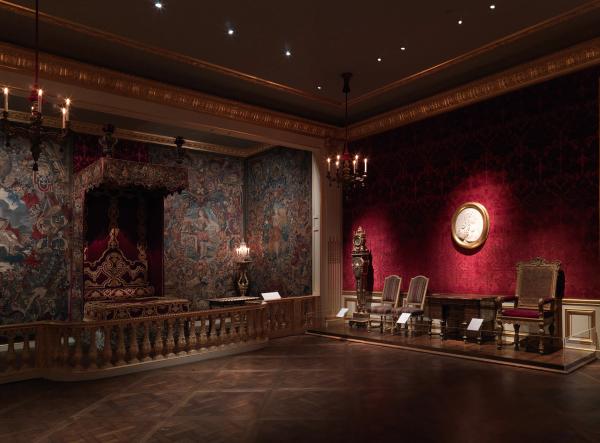
NARRATOR: This room evokes the grandeur of a state bedchamber during the glorious reign of Louis XIV. State bedchambers like this were used for formal receptions and important court ceremonies. So here, lining the walls of a bed alcove are rare precious embroideries. They were commissioned by Madame de Montespan, who was Louis XIV’s longtime mistress. They were originally part of a set of eight hangings, and represent the seasons and elements. To the left of the bed, symbolizing Air is the King himself. He soars on an eagle clasping a thunderbolt, like the god Jupiter. Louis XIV also likened himself to Apollo the sun god, which is reflected by the large sunburst above his head. The other three hangings show three of the King and Madame de Montespan’s six children. To the right of the bed is their son, the Duc de Maine, representing Fire. And, on each end, are two daughters – Mlle. Nantes as Spring and Mlle. Blois as Summer. Curator Danïelle Kisluk-Grosheide.
DANIËLLE KISLUK-GROSHEIDE: The fact that these embroideries have survived is particularly special not only because textiles are very fragile in general. But also in the background and you can see it when you come really close up to the balustrade, you can see that the ground is all embroidered with silver thread.
NARRATOR the silver thread is tarnished today. But imagine how mesmerizing these embroideries must have been, shimmering under the glow of flickering candles – one of the sole sources of light during that period. To hear about the strict court etiquette in the royal bedroom of Louis XIV, press play.
Listen to more about this artwork
More Artwork
Press the down key to skip to the last item.
Related Content
Publications
Books, guides, and catalogues published by The Met.
 Free to download
Research Resources
The Met provides unparalleled resources for research and welcomes an international community of students and scholars. The Met's Open Access API is where creators and researchers can connect to the The Met collection. Open Access data and public domain images are available for unrestricted commercial and noncommercial use without permission or fee.
To request images under copyright and other restrictions, please use this Image Request form.
Feedback
We continue to research and examine historical and cultural context for objects in The Met collection. If you have comments or questions about this object record, please contact us using the form below. The Museum looks forward to receiving your comments.